How solar SCADA reduces unplanned downtime at utility-scale plants
Unplanned downtime at a 100 MW solar plant costs roughly $10,000 per hour in lost generation revenue, according to NREL utility-scale solar O&M cost benchmarks. That figure is avoidable. A properly engineered solar SCADA platform correlates inverter alarms, string-level current data, and met-station readings in real time, catching degradation and fault conditions hours before a protection trip takes the block offline.
How solar SCADA catches faults before they become failures
Every utility-scale solar plant generates thousands of data points per minute: DC string voltages, inverter AC output, irradiance, temperature, tracker angles, and communication status. Without automated correlation, an O&M team reviewing next-day logs will miss the pattern that separates a minor deviation from an imminent trip.
A solar SCADA system processes this data stream in real time. It applies configurable alarm thresholds to flag string currents that drop below the statistical baseline for a given irradiance level, inverter output that deviates from the expected kWh model curve, and transformer temperatures trending toward trip limits. Each condition can be detected and a dispatch ticket created within minutes of onset.
EPRI’s documentation on solar plant O&M practices has found that sites relying on next-day report review miss an average of 38% of fault events within the first two hours of onset. That represents generation lost to downtime that a live monitoring layer would have flagged immediately. See how REIG approaches SCADA commissioning for utility-scale plants to understand the full detection architecture.
The second layer of value is root cause isolation. When an inverter trips offline, the question is whether the fault is at the inverter, the combiner, the string fuses, or the AC collection side. A solar SCADA platform with a well-designed tag hierarchy identifies the fault location before the technician leaves the control room, cutting truck rolls and mean time to repair in half.
For a closer look at this, see Solar SCADA Failover Architecture for High Availability Plants.
We cover the details separately in IEEE 1588 PTP Time Sync for Solar SCADA: GPS Clock Field Guide.
We cover the details separately in Solar drone thermal inspection: utility-scale hotspot field guide.
For a closer look at this, see Utility Scale Solar Monitoring vs SCADA: Roles and Layers Defined.
We cover the details separately in DC Ground Fault Detection in Utility-Scale Solar: NEC 690.5 Field Guide.
We cover the details separately in Solar plant frequency response: FFR and synthetic inertia guide.
There is a full breakdown of this topic in Solar plant AC grounding and ground grid design: IEEE 80 field guide.
What a solar SCADA system monitors at the inverter and string level
Inverter-level data points
At the inverter level, a solar SCADA system typically collects AC power output, DC bus voltage, DC input current per MPPT channel, reactive power, power factor, fault registers, and operational state. For a 100 MW plant with 40 central inverters, that is roughly 240 data points per inverter per scan cycle, arriving every 5 to 15 seconds depending on the polling architecture.
String and combiner monitoring
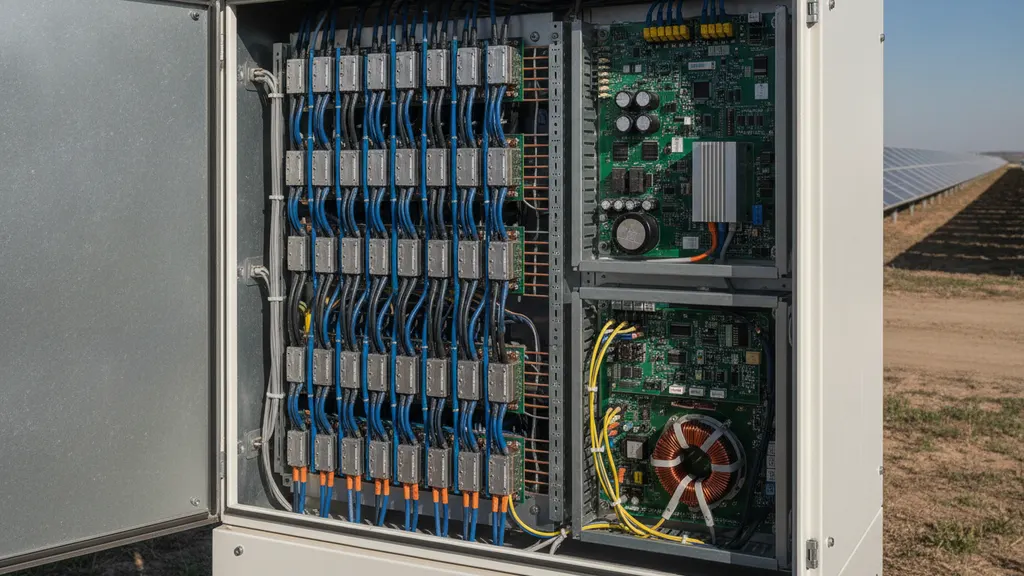
At the string level, the monitoring architecture determines the precision of fault location. Current transformer arrays inside combiner boxes feed string-level DC current data into the data acquisition system, which the SCADA platform then aggregates. IEEE 1547-2018 defines interconnection requirements that align with the signal quality standards a monitoring system must meet at the point of common coupling.
Beyond electrical parameters, a mature monitoring program tracks irradiance from on-site pyranometers and soiling sensors, module temperature via backsheet probes, tracker azimuth and elevation angle versus commanded position, combiner box door status and internal temperature for thermal runaway prevention, and revenue-grade meter output cross-referenced against SCADA-summed inverter output for discrepancy detection. Read REIG’s guide to DAS vs. SCADA for utility-scale solar for a deeper comparison of data layer architectures.
For a closer look at this, see Solar plant SCADA system modernization: a utility upgrade roadmap.
For a closer look at this, see SunSpec Modbus inverter: register maps for utility-scale solar plants.
Solar SCADA alarm management and O&M dispatch integration
Alarm management is where most monitoring programs fail. A well-instrumented plant can generate hundreds of alarm events per day, and without a structured alarm philosophy, the O&M team becomes desensitized to the alert stream. ISA-18.2 (Management of Alarm Systems for the Process Industries) provides a framework that applies directly to solar plant operations.
The three-tier alarm philosophy from process industries translates directly to solar:
| Priority | Condition example | Response window |
|---|---|---|
| P1: Immediate | Inverter offline, >5% of block generation lost | Dispatch within 15 minutes |
| P2: Scheduled | Single string current 20% below baseline for >2 hours | Next available truck roll |
| P3: Deferred | Soiling sensor trending 3% above monthly average | Include in scheduled maintenance |
Integrating the solar SCADA alarm output with a computerized maintenance management system (CMMS) closes the dispatch loop. When a P1 alarm fires, the SCADA system creates a work order, assigns it to the on-call technician, and timestamps both the detection event and the resolution. FERC Order 881 documentation on ambient-adjusted transmission ratings points to the regulatory direction toward real-time operational data, a principle that applies equally to solar plant performance monitoring.
This integration also builds the failure mode library that informs future alarm threshold calibration. After 12 to 18 months of CMMS-linked operations, patterns emerge: which inverter models trip on high DC bus voltage, which tracker rows accumulate shading losses, and which combiner locations show persistent thermal issues.
For a closer look at this, see Solar SCADA Alarm Rules: Cut Nuisance Noise on Utility-Scale Plants.
We cover the details separately in Solar tracker SCADA integration: backtracking and tag map design.
For a closer look at this, see BESS SCADA Integration for Utility-Scale Solar Plants: A Field Guide.
For a closer look at this, see Solar Curtailment and AGC in Utility-Scale Solar Plant Operations.
For a closer look at this, see Solar SCADA Alarm Rules: Cut Nuisance Noise on Utility-Scale Plants.
For a closer look at this, see Solar Power Plant Controller: SCADA Integration, Setpoints, Limits.
Connecting monitoring data to your CMMS and O&M workflow
Data that stays in the monitoring platform is only half the solution. The other half is the workflow that gets a technician to the right location with the right parts before the fault escalates to a forced outage.
The standard integration path uses OPC-UA or Modbus TCP to bridge the solar SCADA layer to the historian, and REST API webhooks or direct database writes to push alarm events into the CMMS. NIST SP 800-82r3 (Guide to OT Security) cautions against direct internet-routable connections between operational technology and business systems, recommending a data diode or DMZ architecture for this bridge.
For plants with multiple sites under one O&M contract, the aggregated monitoring view is where the business case for real-time monitoring becomes clearest. A single O&M engineer can oversee 500 MW of capacity from one screen, prioritizing dispatch across sites by generation impact rather than alarm time. Sites that still rely on inverter-native web portals and email-based alert forwarding have no equivalent capability.
EIA Form 923 data shows that forced outage rates at utility-scale solar plants average 1.8% annually. For a 200 MW plant operating at a 25% capacity factor with a $30/MWh PPA, that represents roughly $700,000 in annual generation loss. Reducing forced outages by 40% through real-time monitoring and faster dispatch converts directly to $280,000 in retained revenue per year, a compelling payback for monitoring infrastructure investment. REIG’s overview of utility-scale solar monitoring protocols covers the ROI calculation in detail.
Solar SCADA cybersecurity and NERC CIP compliance
Plants that connect to the bulk electric system above certain voltage and capacity thresholds fall under NERC CIP reliability standards. CIP-002 through CIP-014 define requirements for cyber asset identification, access management, incident reporting, and physical security that apply directly to solar control systems.
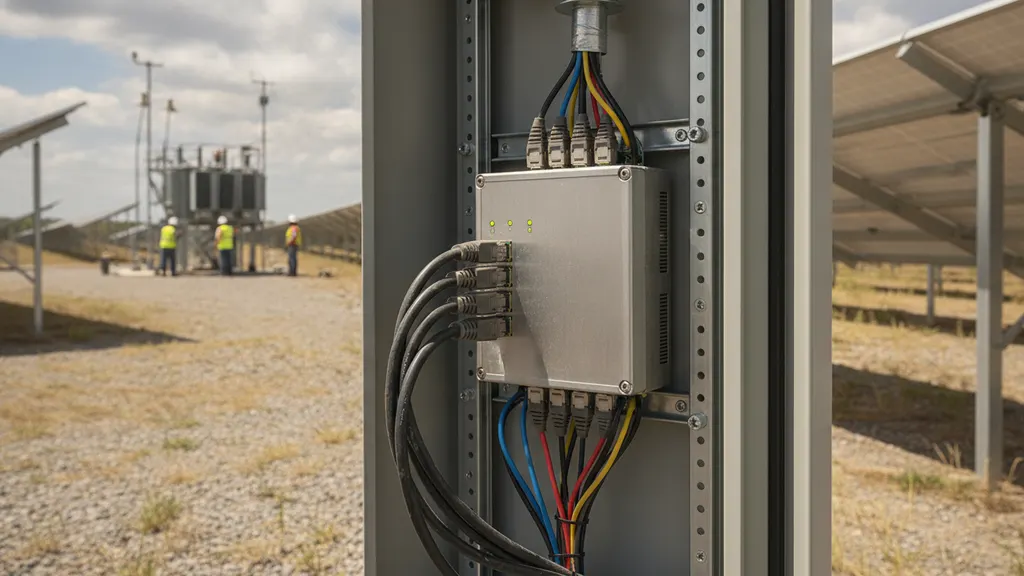
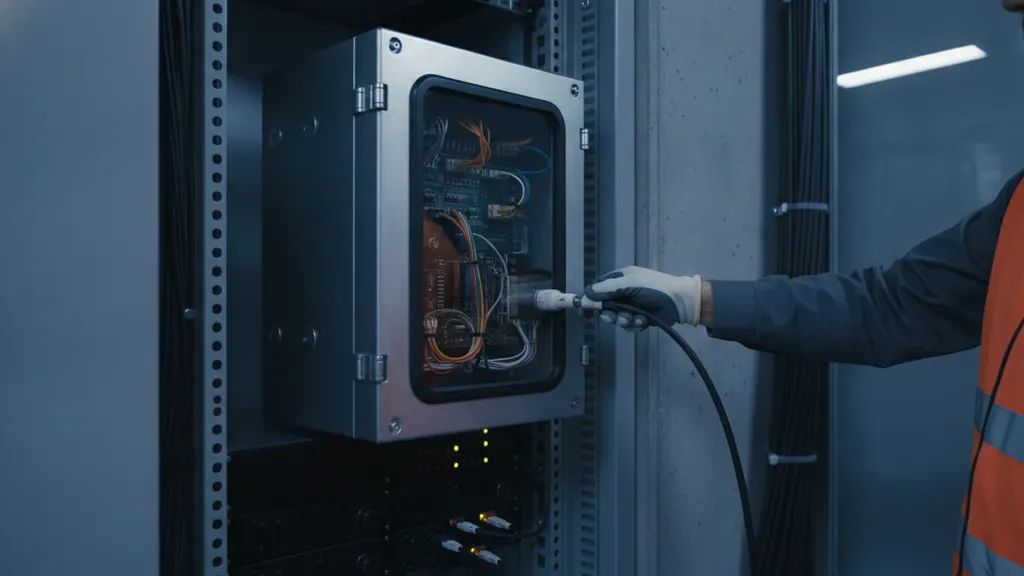
The solar SCADA network is the primary cyber attack surface at a utility-scale plant. NERC’s E-ISAC tracks active threat campaigns against ICS and SCADA infrastructure. Segmenting the monitoring network from corporate IT using a demilitarized zone with unidirectional security gateways is the minimum architecture recommended by both NERC CIP and NIST SP 800-82.
Specific controls that every plant should implement include role-based access control with multi-factor authentication on all SCADA workstations, network segmentation between inverter communications and business systems, encrypted Modbus TCP or DNP3 Secure Authentication v5 for field device communications, quarterly vulnerability scans and patching schedules for HMI software, and offline backup of SCADA configuration files tested for restore within four hours.
The commissioning phase is the right time to conduct a cyber risk assessment using the ISA-99 (IEC 62443) framework. Retrofitting security controls onto an operational plant costs three to four times more than designing them in at the outset. See REIG’s breakdown of solar plant data acquisition architecture for the network topology we recommend.
For a closer look at this, see Solar SCADA cybersecurity NERC CIP: utility-scale compliance guide.
Frequently asked questions
How does solar SCADA reduce unplanned downtime at a plant?
A solar SCADA system continuously correlates inverter output, string currents, and meteorological data to detect fault patterns before they escalate into full outages. When an inverter’s output drops below its expected kWh curve for the current irradiance level, the alarm fires within minutes rather than hours. EPRI research on solar O&M practices documents a measurable reduction in fault events that go undetected for more than two hours when continuous monitoring is active. Combined with CMMS integration, the alarm-to-dispatch cycle that once took several hours now completes in under 30 minutes.
What data points should a utility-scale solar monitoring system track?
The core monitoring dataset includes DC string current per combiner, inverter AC output, DC bus voltage, MPPT channel data, irradiance (GHI and POA), module backsheet temperature, tracker azimuth and elevation, and revenue-grade meter output. NREL commissioning best practices identify the revenue meter cross-check against SCADA-summed inverter output as a tier-1 alarm condition. Combiner thermal data and communication link status are frequently underspecified in early monitoring designs and become the primary sources of missed fault detection within the first operating year.
How long does it take to implement SCADA at a utility-scale solar plant?
A greenfield SCADA deployment on a 100 MW plant typically requires 12 to 20 weeks from design kickoff to full commissioning acceptance, assuming communication paths, network architecture, and tag databases are defined in the EPC scope. Retrofitting a monitoring system onto an operational plant adds 4 to 8 weeks for site surveys, cable routing, and minimizing production impact during switchover. ISA-99 (IEC 62443) recommends conducting a cybersecurity risk assessment during the design phase, before any hardware is racked, to avoid costly retrofits to the network architecture.
What cybersecurity standards apply to solar plant SCADA systems connected to the bulk electric system?
Plants above the low-impact BES threshold under NERC CIP are subject to CIP-002 through CIP-014, covering cyber asset identification, access management, incident response, and physical security. NIST SP 800-82 provides the technical implementation framework for SCADA network segmentation and patch management. Both NERC and NIST recommend a demilitarized zone between the operational technology network and corporate IT, with unidirectional security gateways for historian data replication. For plants under medium or high NERC CIP impact ratings, annual compliance audits are mandatory.