
IEEE 1588 PTP Time Sync for Solar SCADA: GPS Clock Field Guide
Sub-100 nanoseconds. That is the accuracy a GPS-disciplined grandmaster clock delivers relative to UTC per IEEE 1588-2019, and it is why IEEE 1588 PTP solar SCADA time synchronization has moved from optional to mandatory at utility-scale plants. When a disturbance recorder timestamps a fault 2 ms late, the NERC investigator sees an ambiguous sequence of events. This field guide walks through the standard, the hardware, and the audit-ready verification your team needs before commissioning.
Why IEEE 1588 PTP solar SCADA time synchronization matters for NERC CIP event logs
Millisecond-accurate timestamps across every intelligent electronic device are what NERC CIP auditors require at utility-scale solar plants. A 100 MW site runs dozens of protection relays, RTUs, and disturbance recorders, and a single drifting clock turns a clear fault record into an ambiguous sequence that stalls root-cause analysis for days.
Disturbance records, sequence-of-events data, and cyber-security logs from those devices must be ordered within a millisecond for investigators to reconstruct any fault. Auditors ask for documented evidence that IEEE 1588 PTP solar SCADA time synchronization meets the millisecond threshold across the full plant, not just on the SCADA server rack. Software NTP tops out at 1 to 10 ms accuracy on a loaded plant network. That range is fine for a mail server, not for a substation. PTP hardware timestamping records packet arrival in the MAC layer, removing operating-system jitter. The NIST Time and Frequency Division maintains the reference standards a plant grandmaster disciplines against. Pair that upstream traceability with a well-designed PTP domain and every relay, RTU, and historian stamps events on the same nanosecond-accurate clock.
For a closer look at this, see BESS SCADA Integration for Utility-Scale Solar Plants: A Field Guide.
We cover the details separately in How solar SCADA reduces unplanned downtime at utility-scale plants.
We cover the details separately in Solar Farm Revenue Metering: ANSI C12.20 Accuracy Field Guide.
There is a full breakdown of this topic in Solar drone thermal inspection: utility-scale hotspot field guide.
We cover the details separately in Solar SCADA cybersecurity NERC CIP: utility-scale compliance guide.
For a closer look at this, see Solar tracker SCADA integration: backtracking and tag map design.
For a closer look at this, see IEEE 1547 solar interconnection: voltage ride-through guide.
We cover the details separately in Solar SCADA Alarm Rules: Cut Nuisance Noise on Utility-Scale Plants.
For a closer look at this, see Solar Power Plant Controller: SCADA Integration, Setpoints, Limits.
For a closer look at this, see Fiber optic installation solar farm: OTDR testing field guide.
For a closer look at this, see Utility Scale Solar Monitoring vs SCADA: Roles and Layers Defined.
For a closer look at this, see Solar plant SCADA system modernization: a utility upgrade roadmap.
We cover the details separately in Solar SCADA commissioning: building the utility witness pack.
For a closer look at this, see Modbus TCP vs DNP3: solar SCADA protocol guide for utility plants.
For a closer look at this, see Solar SCADA Failover Architecture for High Availability Plants.
For a closer look at this, see Solar farm arc flash analysis NFPA 70E: IEEE 1584 and PPE guide.
There is a full breakdown of this topic in DC Ground Fault Detection in Utility-Scale Solar: NEC 690.5 Field Guide.
For a closer look at this, see Solar plant AC grounding and ground grid design: IEEE 80 field guide.
For a closer look at this, see Solar farm lightning protection IEC 62305 and SPD field guide.
We cover the details separately in Solar string IV curve tracing: field methods for degradation detection.
We cover the details separately in Solar substation transformer differential protection: IEEE C37.91 guide.
We cover the details separately in Solar plant transformer DGA: dissolved gas analysis field guide.
How IEEE 1588-2019 PTPv2.1 achieves sub-microsecond accuracy
IEEE 1588 PTP solar SCADA time synchronization begins with a two-step Sync and Delay exchange. The master sends a Sync message, the slave responds with Delay_Req, and the master returns Delay_Resp. Symmetric path delay lets the slave compute its offset with sub-microsecond precision when both directions capture timestamps in hardware. Ethernet switches must be PTP-aware or that precision is lost inside the first hop.
The 2019 revision adds security extensions (Prong A and Prong B TLVs), improved holdover behavior, and better handling of asymmetric paths. For solar substations, the Power Utility Profile defined in IEC/IEEE 61850-9-3 constrains the parameter set: one-step operation, peer-delay mechanism, and a one second Sync interval. Specify that profile on the SCADA architecture drawings so vendors bid interoperable equipment rather than proprietary variants.
Grandmaster, boundary, and transparent clock hierarchy for IEEE 1588 PTP solar SCADA time synchronization
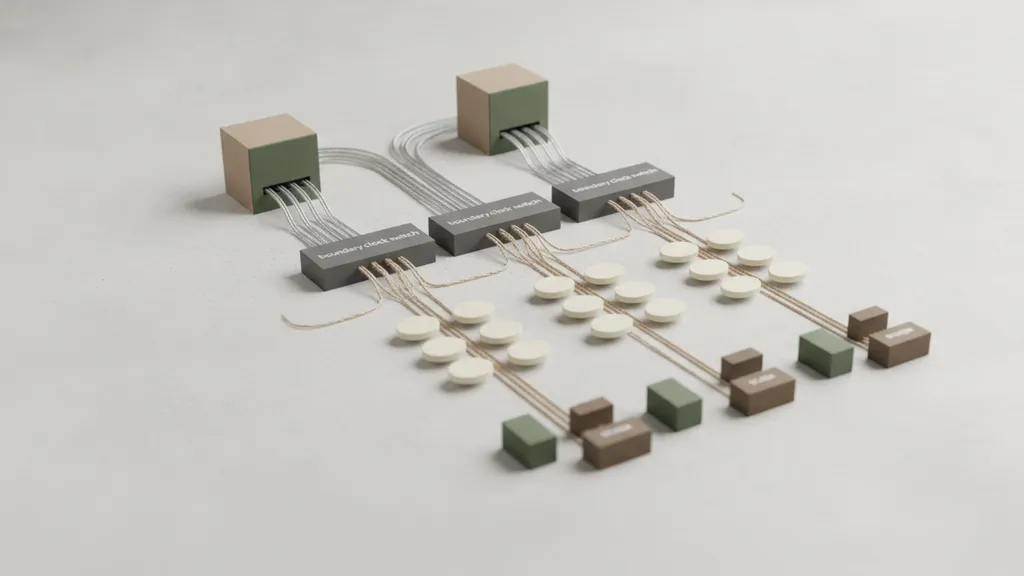
Three device roles carry time from the GPS antenna to the last protection relay. The grandmaster is the source, disciplined by GNSS. Boundary clocks are switches that terminate one PTP domain on the uplink and re-originate it on downlink ports, keeping cascading error bounded. Transparent clocks measure how long a packet dwelled in the switch and correct the residence time inside the message itself before forwarding.
Most utility-scale designs settle on a two-tier layout. A pair of grandmasters in the substation control building. Ruggedized boundary-clock switches in every combiner-block skid, connected by single-mode fiber to the substation core. Transparent clocks are acceptable inside a skid where hop counts stay low. Do not cascade more than eight boundary clocks without measuring cumulative offset during commissioning, or accuracy drifts past the 1 microsecond internal budget most audit checklists reference.
GPS-disciplined oscillator selection and redundancy at the substation
The grandmaster anchors IEEE 1588 PTP solar SCADA time synchronization on the site. Specify an OCXO or Rubidium holdover oscillator so a 24 hour GNSS outage does not blow past the 1 ms audit budget. A high-quality OCXO holds within 1 microsecond for roughly eight hours; a Rubidium oscillator extends that window to a full day.
Redundancy matters. Deploy two grandmasters with independent GNSS antennas on opposite corners of the substation building, each on separate UPS branches. Configure the Best Master Clock Algorithm with explicit priority1 and priority2 values so failover is deterministic rather than a coin flip. Antenna surge suppression is required by OSHA-required lightning protection codes, and arrestors must be inspected annually. See our related note on plant controller integration for how PTP redundancy interacts with the PPC.
| Oscillator type | Holdover to 1 us | Cost tier | Typical role |
|---|---|---|---|
| TCXO | Under 1 hour | Low | Boundary clocks |
| OCXO | 4 to 8 hours | Medium | Small plant grandmaster |
| Rubidium | 24+ hours | High | Utility-scale grandmaster |
| Chip-scale atomic | Days | Very high | Transmission substations |

Verifying IEEE 1588 PTP solar SCADA time synchronization for the NERC CIP audit
Auditors do not accept “PTP is running” as evidence: they want a 24 hour monitoring log capturing offset from master, mean path delay, and grandmaster identity at every RTU, protection relay, phasor measurement unit, and SCADA historian. A well-tuned plant shows offset under 1 microsecond with no unexpected BMCA transitions during the capture window.
The IEC/IEEE 61850-9-3 Power Utility Profile defines the parameter set. Our SCADA commissioning witness pack template includes a PTP verification section auditors accept without pushback. During audit, the team wants proof that IEEE 1588 PTP solar SCADA time synchronization is measurable and not just installed. Pair the log with alarms from PTP-aware switches so any grandmaster failover produces an ISO 8601 timestamped event in the historian record.

Common IEEE 1588 PTP solar SCADA time synchronization failure modes
Most brownfield IEEE 1588 PTP solar SCADA time synchronization defects trace to three causes: asymmetric path delay from mixed fiber and copper hops, incompatible Power Utility Profile settings between OT vendors, and GNSS antenna coax exceeding 30 meters without an in-line amplifier. Each cause produces 1 to 5 microsecond silent offset that only surfaces during post-fault review.
The path asymmetry problem builds when fiber runs one direction and copper returns the other across a segment: PTP assumes symmetric delay, so a 10-microsecond difference between forward and return delays produces a 5-microsecond offset error at every slave clock. Incompatible profiles create parameter mismatches in Sync interval or delay mechanism that prevent stable lock and cause BMCA transitions to appear in the historian log without explanation. Coax exceeding 30 meters adds propagation delay the grandmaster cannot self-compensate unless an in-line amplifier with a documented delay figure is installed in the cable run. The DOE Solar Energy Technologies Office reliability program has published lessons-learned reports covering all three failure modes, and they account for the majority of PTP offset violations found during NERC CIP commissioning audits across the country.
Fix asymmetry by using identical media in both directions of each path segment. Enforce Power Utility Profile compliance in the procurement specification, not as an afterthought during factory acceptance testing. Keep GNSS coax under 30 meters unless you deploy an in-line amplifier with a documented delay figure. During a 2024 commissioning at a 180 MW plant in the Carolinas, our team traced a persistent 3 ms offset to a single non-PTP managed switch in a combiner-block skid that had passed initial factory acceptance testing, illustrating how profile noncompliance hides until a 24-hour capture log exposes it. REIG Solar has commissioned PTP timing systems at more than 30 utility-scale solar plants across the Southeast and Midwest, and this failure pattern accounts for roughly one in four brownfield timing defects we document. For related governance, see our NERC CIP cybersecurity field guide and the IEC 61850 substation guide covering GOOSE and Sampled Values traffic that shares the same clock domain.
Frequently asked questions
What is the difference between NTP and PTP for solar SCADA?
NTP synchronizes computer clocks over IP networks to accuracy of 1 to 10 milliseconds on a loaded plant network. PTP, defined in IEEE 1588-2019, drives that to sub-microsecond by capturing packet timestamps in the MAC-layer hardware of PTP-aware switches. For utility-scale solar, where NERC CIP audit records require millisecond accuracy across protection relays and disturbance recorders, PTP is the only practical option. IEEE 1588 PTP solar SCADA time synchronization also carries better security extensions in the 2019 revision, which suits high- and medium-impact BES Cyber Systems that NTP was not designed for.
Does NERC CIP require IEEE 1588 PTP specifically?
NERC CIP-002-5.1a and CIP-007 require accurate timestamps on security event logs and specify a 1 millisecond target for high- and medium-impact BES Cyber Systems. The standards do not name PTP, but achieving that level of accuracy across dozens of substation devices on a plant Ethernet network is impractical with software NTP. PTP with hardware timestamping is the accepted engineering path, referenced in NERC CIP guidance documents. Auditors will accept NTP if you can document sustained sub-millisecond offset, but very few plants can prove it in the field.
How many grandmaster clocks does a utility-scale solar plant need?
Two, minimum. Deploy them in the substation control building with independent GNSS antennas mounted on opposite corners of the roof, on separate UPS branches. The Best Master Clock Algorithm chooses the active grandmaster by configured priority values, so set priority1 and priority2 explicitly on both units rather than accepting defaults. IEEE 1588 PTP solar SCADA time synchronization stays healthy through a single antenna failure, coax cut, or receiver reboot when redundancy is designed correctly. A third grandmaster in the interconnection substation is common on plants above 200 MW where distance creates additional risk.
Can I use existing plant switches or do I need PTP-aware hardware?
Non-PTP-aware switches add microseconds to milliseconds of jitter per hop, breaking the accuracy budget. Every switch in the path between grandmaster and endpoint must be either a boundary clock or a transparent clock supporting the Power Utility Profile (IEC/IEEE 61850-9-3). Legacy managed switches without hardware timestamping introduce enough error to fail the NERC audit target. When retrofitting, plan on replacing all substation-layer switches during the SCADA modernization project so the audit trail stays clean end to end. Specify IEC/IEEE 61850-9-3 hardware timestamping compliance as a line item in the switch procurement specification and verify conformance during factory acceptance testing before equipment ships to the site.
How do I verify PTP accuracy in the field during commissioning?
Every PTP-aware switch and endpoint exposes counters for offset from master, mean path delay, and grandmaster identity. Poll them over SNMP or REST during a 24 hour commissioning window and archive the samples. Cross-check by connecting a portable GPS-referenced time-interval counter, such as a Microsemi SyncServer or equivalent 1 PPS analyzer, to outputs on the grandmaster and a downstream boundary clock to measure end-to-end offset directly. Record both results in the audit witness pack. Reference EPRI substation timing test procedures for the full parameter list a utility protection engineer expects to see in the commissioning record.
What holdover time should I specify for the grandmaster oscillator?
Match the holdover to your operational risk tolerance during GNSS outages. An OCXO holds within 1 microsecond for four to eight hours, which covers a typical antenna maintenance window. A Rubidium oscillator extends that window to a full 24 hours, which covers most jamming or spoofing events long enough for corrective action. Chip-scale atomic clocks push holdover to days but at much higher cost. For utility-scale solar in the US, a Rubidium-disciplined grandmaster is the standard specification per NIST recommendations, and it removes a common single point of failure.