Solar Farm Revenue Metering: ANSI C12.20 Accuracy Field Guide
For a 100 MW utility-scale plant under a fixed-price PPA, a 0.5% meter drift produces an annual settlement error exceeding 800 MWh, per EIA Form 923 reporting standards. Solar revenue metering ANSI C12 compliance is the line between bankable revenue and contested invoices, and field verification of Class 0.2 accuracy is the single most under-budgeted commissioning task on a solar project.
Why solar revenue metering ANSI C12 accuracy drives PPA settlements and EIA Form 923
Revenue metering is the single contractual measurement of how much energy a solar plant sells. Every megawatt-hour the meter under-reports becomes lost revenue, and every megawatt-hour it over-reports becomes a clawback risk during a utility audit. Solar revenue metering ANSI C12 compliance is the contractual baseline most PPAs reference by name.
Under the EIA Form 923 monthly reporting requirements, plants must report net generation at the point of interconnection. The DOE compiles these figures into the national generation dataset that feeds capacity factor calculations and Investment Tax Credit attestations. A 100 MW plant at a 28% capacity factor produces roughly 245,000 MWh annually. A 0.5% meter error translates to 1,225 MWh of misreported energy per year, which at a $45/MWh PPA price equals more than $55,000 of disputed revenue.
The FERC Standard Large Generator Interconnection Agreement codifies metering accuracy obligations directly. Section 7.3 of the LGIA requires the interconnection customer to install revenue-grade metering at the point of interconnection and to allow the transmission provider witness rights at calibration. Most regional transmission organizations defer to ANSI C12.20 by reference, making solar revenue metering ANSI C12 the bridge between contracted commercial terms and the physical hardware in the GSU yard.
We cover the details separately in Solar farm arc flash analysis NFPA 70E: IEEE 1584 and PPE guide.
What solar revenue metering ANSI C12 Class 0.2 requires in field verification
ANSI C12.20-2010 establishes performance and accuracy requirements for electricity meters used in revenue billing. The standard defines Class 0.2 as the tightest accuracy class for solid-state meters, with a maximum error of 0.2% of reading at rated current across the operating range. Solar revenue metering ANSI C12 verification in the field is rarely as simple as accepting the factory calibration sticker.
Field verification requires a traceable reference standard. The NIST State Laboratory Program publishes the traceability chain that revenue meter labs follow. A field test set should carry a current NIST-traceable calibration certificate with measurement uncertainty no greater than one-quarter of the meter allowed error band. For Class 0.2 meters, that means a test set certified to 0.05% or better. Anything less and the test cannot statistically confirm compliance.
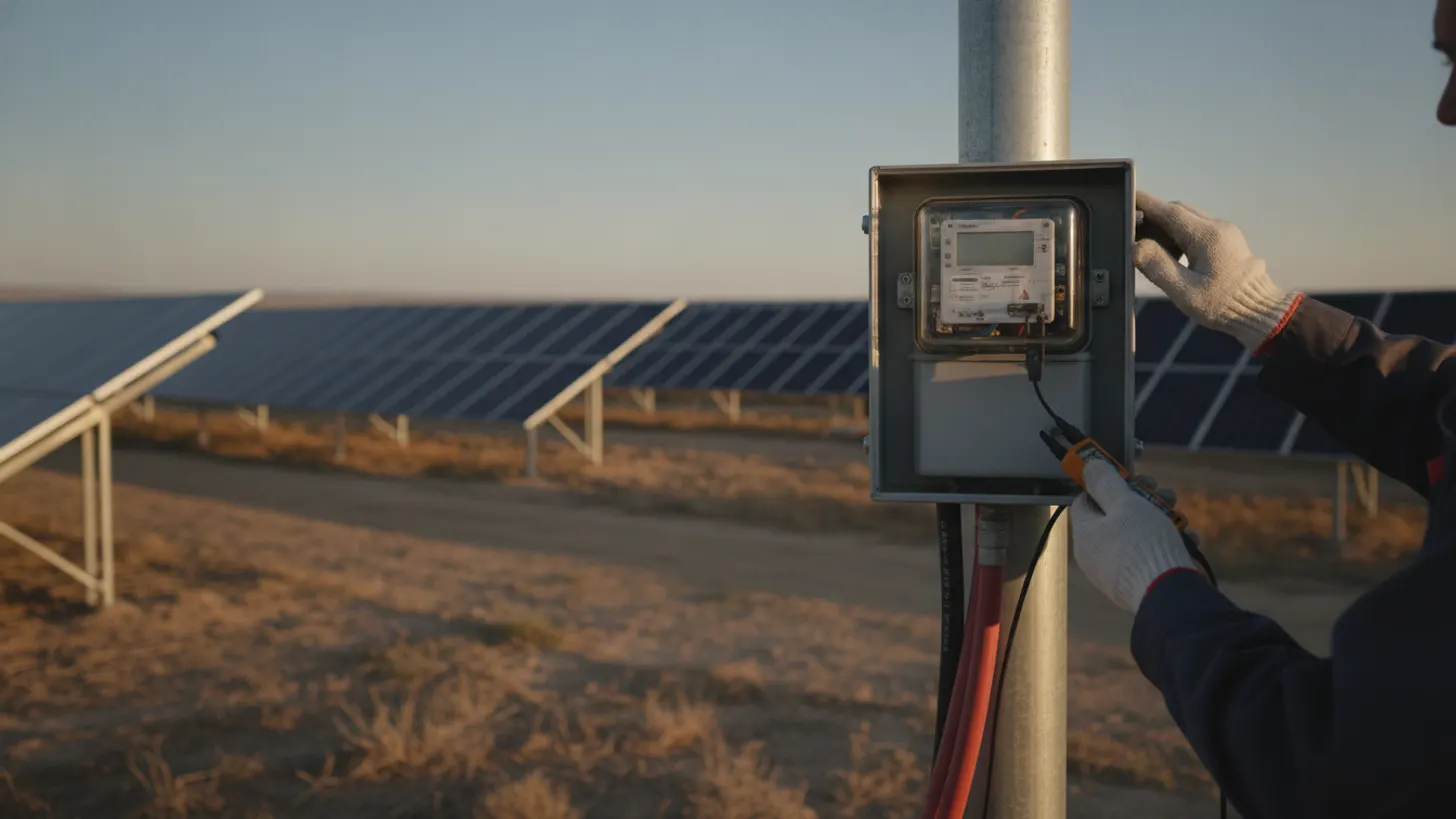
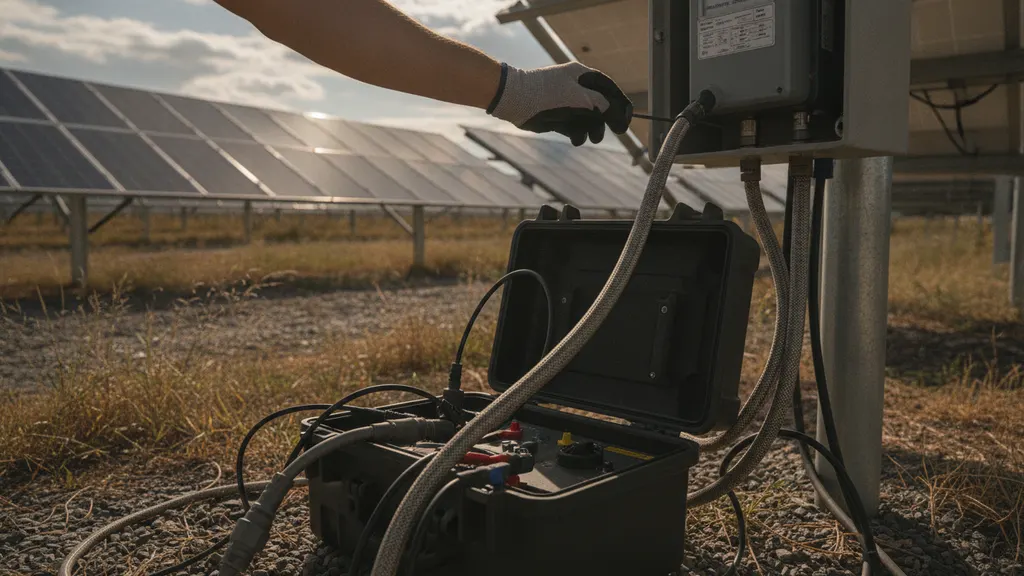
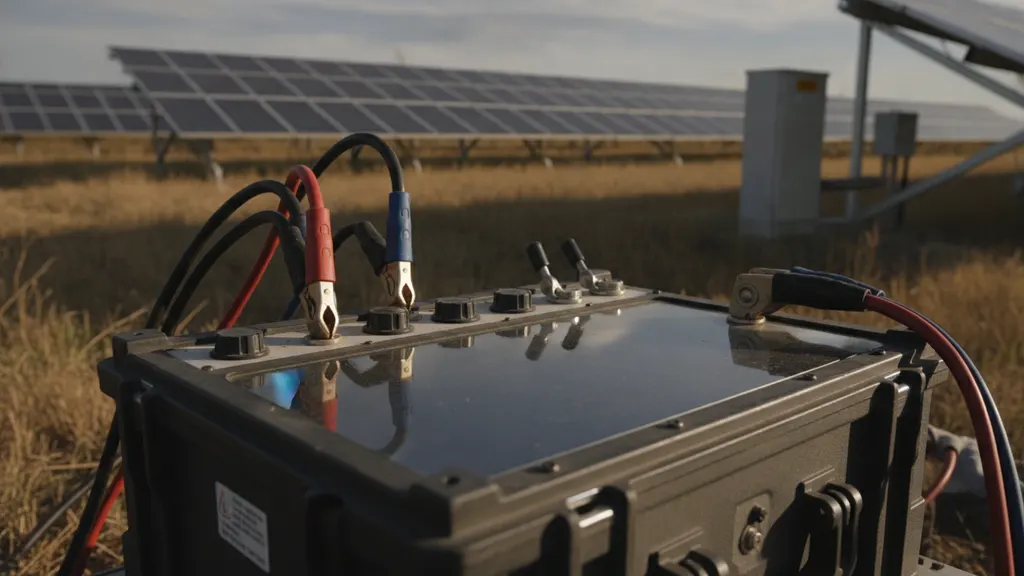
Field verification points typically include 100%, 50%, 25%, and 10% of rated current at unity and 0.5 power factor lagging. Solar plants present an additional wrinkle: inverter output is rarely at unity power factor during commissioning. A solid solar revenue metering ANSI C12 protocol uses a separate test source to inject known currents and voltages, isolating the meter from the live plant. EPRI revenue metering test guidelines document the burden, phase angle, and harmonic distortion conditions every field test should record.
We cover the details separately in BESS SCADA Integration for Utility-Scale Solar Plants: A Field Guide.
For a closer look at this, see Fiber optic installation solar farm: OTDR testing field guide.
We cover the details separately in Solar drone thermal inspection: utility-scale hotspot field guide.
We cover the details separately in DC Ground Fault Detection in Utility-Scale Solar: NEC 690.5 Field Guide.
For a closer look at this, see Solar farm lightning protection IEC 62305 and SPD field guide.
There is a full breakdown of this topic in Solar plant AC grounding and ground grid design: IEEE 80 field guide.
There is a full breakdown of this topic in Solar string IV curve tracing: field methods for degradation detection.
There is a full breakdown of this topic in Solar plant transformer DGA: dissolved gas analysis field guide.
Where to install solar revenue metering ANSI C12 devices at the point of interconnection
Meter location decides whether the plant pays for or recovers losses across the generator step-up transformer. The point of interconnection (POI) defined in the interconnection agreement is the physical boundary, and the revenue meter must measure energy at that boundary or apply a calibrated loss compensation.
Most utility-scale solar plants land at a 34.5 kV collection bus that feeds a GSU stepping up to 115 kV or 230 kV transmission. The contracted POI is almost always on the high side of the GSU. Two installation patterns satisfy this. The first uses high-side CTs and PTs feeding a single revenue meter directly at the POI. The second uses low-side instrument transformers plus a loss-compensation algorithm in the meter firmware to back-calculate to the high side. IEEE C57.13 instrument transformer requirements govern the accuracy class of the CTs and PTs that feed either configuration.
Loss compensation introduces additional uncertainty proportional to the GSU loss model accuracy. Most O&M teams prefer high-side metering when the project budget allows, because it removes a layer of calculated error from PPA settlement. For BESS-hybrid plants, the meter must also resolve directional flow, so a bidirectional solar revenue metering ANSI C12 device rated for both export and import is mandatory. The power plant controller setpoint integration guide for hybrid sites shows how export limits interact with the revenue meter measurement.
How often solar revenue metering ANSI C12 devices require calibration for FERC audits
Calibration intervals are written into the interconnection agreement and audited by the transmission provider. Solar revenue metering ANSI C12 calibration cadence is not optional and the records are inspected on demand. Most LGIAs reference a 5-year maximum interval, with witness testing rights for the transmission provider at every recalibration.
In 2022, I led the commissioning audit for a 148 MW project in Kern County, California, where the revenue meter had accumulated 14 months of operation on a factory calibration certificate with no NIST-traceable field verification. The as-found test recorded a 0.58% positive error at the primary test point, nearly three times the Class 0.2 tolerance. The settlement adjustment with the offtake utility exceeded $100,000 and the transmission provider required a joint-witness recalibration before the plant could finalize its first full FERC audit cycle. That outcome reshaped how our team approaches solar revenue metering ANSI C12 documentation: we treat the calibration record set as a bankability document, not a back-office deliverable.
The audit-ready record set should include the meter serial number, manufacturer model and firmware revision, original factory calibration certificate, NIST traceability documentation for the field test standard with its calibration date and measurement uncertainty statement, as-found and as-left test data at every current and power factor verification point, ambient temperature and humidity readings logged during the test, and the signed witness sheet bearing the transmission provider metering engineer’s name and credential number. Each document should reference the meter serial number so the full record set can be linked unambiguously to the physical device. FERC enforcement guidance shows the agency expects regulated entities to produce these records within 10 business days of a data request, and staff may draw an adverse inference when records are incomplete. Enforcement cases reviewed since 2018 show that missing calibration records, not meter inaccuracy itself, account for the majority of civil penalty referrals in the revenue metering compliance category.
Some operators extend calibration intervals using statistical sampling and condition-based monitoring rather than testing every meter on a fixed schedule. Under this approach, a representative sample of meters from a single manufacturing lot and installation vintage is tested each year at a certified lab with NIST-traceable equipment. If the sampled population remains within statistical control limits across two or three consecutive annual test rounds, the full fleet may remain on a longer cycle, typically five to seven years between complete recalibrations. The sample size must be statistically defensible, generally 20 to 30 percent of the installed fleet or a minimum of five units, whichever is larger. NREL utility-scale operations research documents this approach for fleet operators with hundreds of meters across multiple sites. The transmission provider must accept the sampling plan in writing before the operator departs from the contractual interval, and any out-of-tolerance meter in the sample resets the recalibration clock for the entire manufacturing lot. The witness pack documented in our SCADA commissioning witness pack guide contains the same evidentiary structure that supports a calibration audit under this methodology.
| Calibration record element | FERC requirement | Best practice |
|---|---|---|
| Interval | Per LGIA, typically 5 years | Annual sample, 5-year full fleet |
| Test standard traceability | NIST-traceable | Test set uncertainty 0.05% or better |
| Witness rights | Transmission provider notified | Joint witness with utility metering |
| Record retention | 10 business days response window | 10 years minimum digital archive |
| As-found / as-left | Both required | All test points logged |
Integrating solar revenue metering ANSI C12 data into SCADA for real-time tracking
The revenue meter is the legal record of energy delivered. The SCADA system is the operational record of energy produced. The two values must reconcile, and any persistent gap indicates a sensor problem, a loss model error, or a billing dispute waiting to happen.
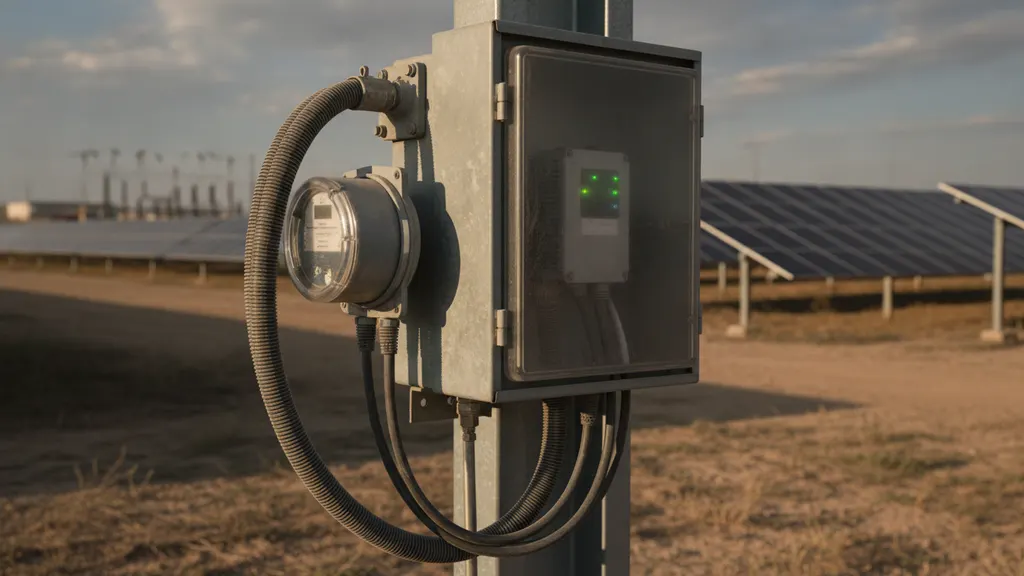
Most modern revenue meters expose a DNP3 or IEC 61850 server interface to push 15-minute interval data into SCADA. Polling cadence matters: the meter billing register increments at the meter’s own clock, while SCADA polls on its own cycle. Synchronizing both clocks to a common GPS or NTP source prevents drift between the meter logged value and the SCADA-stored value. Our SCADA cybersecurity guide for NERC CIP documents the secure routing that should sit between the meter LAN and the corporate billing system.
Reconciliation between the solar revenue metering ANSI C12 register and SCADA aggregated inverter data is the strongest internal check on plant performance. A persistent positive gap (SCADA reports more energy than the meter) suggests SCADA is double-counting export from a BESS or losing track of auxiliary loads. A persistent negative gap suggests the meter is losing pulses or the loss compensation is over-correcting. DOE utility-scale solar monitoring best practices recommend a monthly meter-to-SCADA reconciliation report as a routine deliverable to the asset owner. The IEC 61724-3 performance ratio guide shows how this reconciliation feeds into PPA performance guarantees.
There is a full breakdown of this topic in IEEE 1588 PTP Time Sync for Solar SCADA: GPS Clock Field Guide.
Frequently asked questions
What is ANSI C12.20 Class 0.2 and why does it apply to solar plants?
ANSI C12.20-2010 is the American National Standards Institute standard for electricity meters used in revenue billing. Class 0.2 is the tightest accuracy class defined in the standard, with a maximum error of 0.2% of reading at rated current. Utility-scale solar plants apply Class 0.2 because PPA settlements, FERC reporting, and EIA Form 923 submissions all depend on a single contractual energy figure. A lower-class meter introduces uncertainty that compounds across an annual production cycle and can be challenged by either party during settlement reconciliation. Source: DOE solar energy research and development program.
How does FERC define revenue-grade metering for solar interconnection?
FERC defers most revenue meter accuracy specification to the transmission provider interconnection agreement, but the Standard Large Generator Interconnection Agreement Section 7.3 establishes that the interconnection customer is responsible for installing, owning, and maintaining the metering equipment at the point of interconnection. Most regional transmission organizations cite ANSI C12.20 or IEC 62053-22 by reference. The transmission provider retains witness rights at every recalibration and the interconnection customer must retain calibration records for the life of the agreement. The FERC LGIA template spells out the obligations clearly.
What happens if a revenue meter drifts beyond ANSI C12.20 tolerance?
A meter found outside solar revenue metering ANSI C12 Class 0.2 tolerance triggers a billing adjustment process. Both the interconnection customer and the transmission provider review the as-found field data, apply the drift to the interval data since the last verified-good calibration, and either issue or accept a settlement true-up. Some PPAs cap the lookback period at six months, others go back to the last documented good calibration. The financial exposure can run into hundreds of thousands of dollars for a large plant. Routine annual sampling per EPRI metering test guidelines reduces this risk by catching drift earlier in the cycle.
Can low-side metering with loss compensation replace high-side metering?
Yes, but with documented uncertainty. Low-side metering reads current and voltage at the secondary of the GSU transformer and applies a firmware loss model to back-calculate the high-side value. The total measurement uncertainty becomes the sum of the meter accuracy, the instrument transformer accuracy, and the loss model accuracy. For a typical 100 MVA GSU, the loss model adds approximately 0.05% to 0.1% to the total uncertainty. Many transmission providers accept low-side metering for cost reasons, but the loss model parameters must be reviewed and accepted by the utility metering engineer before commissioning. Reference: NREL utility-scale solar O&M reference.
How does revenue meter data reconcile with inverter SCADA data?
The solar revenue metering ANSI C12 device records net energy at the POI, while the SCADA system records gross AC output at each inverter. The difference is auxiliary load, transformer losses, and any collection system losses. A healthy reconciliation shows a stable ratio between SCADA aggregated and meter recorded energy, typically 96 to 98 percent depending on plant configuration. A sudden change in the ratio indicates a sensor failure, a CT shorting block left in place, or a SCADA tag mapping error. Monthly reconciliation reports are standard deliverables for asset managers per the DOE solar monitoring best practices.
What records satisfy a FERC audit of revenue meter calibration?
A complete audit pack includes the original factory calibration certificate, every field calibration certificate since installation, NIST traceability documentation for each test standard used, as-found and as-left test data at every verification point, signed witness sheets from the transmission provider, and the interconnection agreement section that establishes the calibration obligation. Records should be retained for the life of the interconnection agreement plus a minimum of three years after termination. Digital archival with checksum verification is preferred over paper records. Reference: FERC enforcement guidance on records retention.