

Solar SCADA Failover Architecture for High Availability Plants
A single uncaught controller failure at a 200 MW solar farm can dark a site for 14 to 48 hours and erase six figures of monthly revenue before the on-call engineer even reaches the substation. Solar SCADA failover architecture exists to make that scenario boring. Done right, a redundant control stack delivers 99.95% annual availability, sub-second cutover between primary and standby servers, and zero data gaps in the historian. Here is the architecture we deploy at REIG.
Why solar scada uptime defines plant ROI
Every minute a 100 MW plant sits offline at noon costs roughly $8,000 in lost generation and capacity payments. A solar scada outage that runs across one sunny afternoon can wipe an entire month of operating margin. The math compounds at portfolio scale.
Across the 92 GW of utility-scale solar interconnected in the US by Q4 2025, a 0.5% uptime improvement returns more than $300 million in annual generation, according to DOE’s Solar Energy Technologies Office. Owners and asset managers now treat the control stack as a Tier-1 revenue protection asset, not a back-office monitoring tool. That reframe drives every architectural choice that follows.
Our O&M directors at REIG benchmark every plant against the NREL 2022 PV reliability dataset, which puts the industry median plant availability at 98.7%. The top quartile reaches 99.6%. That 0.9-point gap, applied to a 200 MW plant, is roughly $1.1 million per year in recovered revenue. That is the prize a properly engineered failover architecture wins.
Related reading: Solar DAS versus SCADA: where the two systems split.
Core components of a solar scada failover stack
A high-availability solar scada deployment has six load-bearing components, and each one needs its own redundancy story. Skip any one and you have built a system that fails on the day the weather turns bad.
1. Redundant SCADA servers
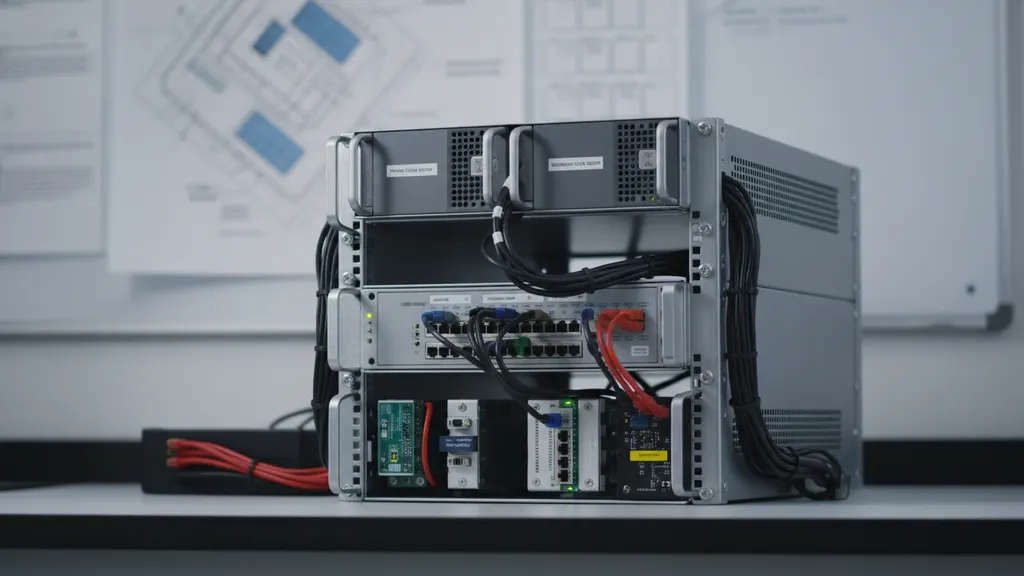
Two physical servers in hot-standby mode, sharing a virtual IP, with synchronous replication of the runtime database. Cutover is triggered by heartbeat loss, not by manual intervention. Both servers run identical OS, identical patch level, and identical SCADA application version.
2. Redundant PLCs at the inverter, tracker, and MET station layers
Field controllers should ride on dual power supplies and dual Ethernet interfaces. PRP or HSR rings give sub-millisecond cutover at the protocol layer, per IEEE 1547-2018.
3. Redundant historians
Plant data has compliance value and dispatch value. Historian replication across two storage nodes, ideally in two physical buildings, protects both. Asset managers typically require 10-year retention.
4. Power Plant Controller (PPC) hot standby
The PPC sits between the SCADA layer and the grid operator. Loss of PPC means loss of AGC, which means a curtailment violation. Hot-standby PPCs are now a standard interconnection requirement at most US ISOs.
5. Communication redundancy
Covered in detail in the next section.
6. Power redundancy
UPS plus generator backup for the control house. 24-hour autonomy minimum. We size for 72 hours on plants in hurricane corridors.

Redundant solar scada server architectures
Three server topologies dominate utility-scale deployments today. Each carries a different cost, complexity, and recovery time profile. Picking the wrong one for your plant size is the most common architectural mistake we see during third-party audits.
Active-passive (cold standby)
Cheapest tier. Standby server is powered on but the SCADA application is not running. Cutover takes 5 to 15 minutes and you lose runtime state. Acceptable for sites under 20 MW with low ancillary service revenue.
Active-passive (warm standby)
Standby server runs the SCADA application but does not own the virtual IP. Database replicates every 1 to 5 seconds. Cutover is 30 to 60 seconds and you may lose 5 seconds of historian data. Fits 20 to 100 MW plants.
Active-active (hot standby)
Both servers run the SCADA application against a shared synchronous database. Cutover is under 1 second and historian data is continuous across the failover. This is the standard for any plant above 100 MW or any plant providing frequency response, per NERC BAL-003-2.
The cost delta between warm and hot is small at the hardware level. The real cost is engineering: shared storage, deterministic networking, and an instrumented heartbeat protocol that does not false-trigger during patch cycles. Get the heartbeat tuning wrong and you create more outages than you prevent.
Communication path diversity for utility-scale plants
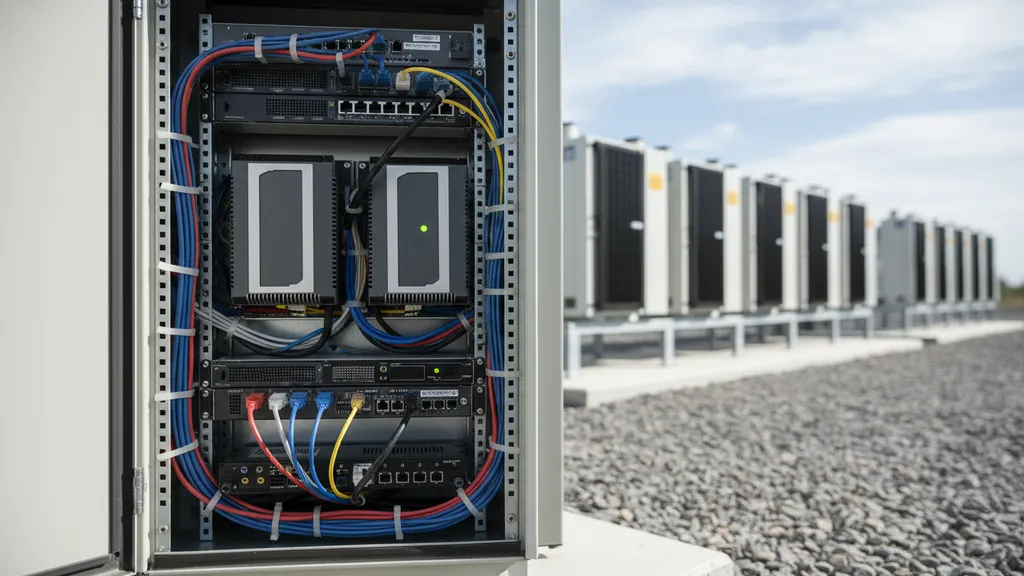
The single biggest source of SCADA outage on US solar plants is not server failure. It is the communications link to the data center or the grid operator. Cellular modems get knocked offline by lightning, fiber gets cut by trenching crews, satellite links degrade in heavy rain. A utility-scale solar plant needs three independent paths.
Our standard build at REIG runs primary fiber to the substation, cellular failover on two separate carriers (Verizon and AT&T at minimum), and an Iridium satellite tertiary path for the PPC dispatch link. Border gateway protocol on the on-site firewall handles route selection. The fail-over decision uses link quality (latency, jitter, packet loss) rather than simple link state, which gives cleaner cutover when a path degrades before it dies.
The EIA Electric Power Monthly tracks plant-level forced outages, and communications failure is the single most common root cause for monitoring-offline events on plants above 50 MW. Solar scada designers should treat the communication layer as the first line of defense, not an afterthought wired in during commissioning.
| Path | Typical latency | Typical availability | Best use |
|---|---|---|---|
| Dedicated fiber | 5-15 ms | 99.9% | Primary SCADA + AGC |
| Carrier-A cellular | 40-80 ms | 99.5% | Secondary SCADA |
| Carrier-B cellular | 40-80 ms | 99.5% | Tertiary SCADA |
| Iridium satellite | 600-1200 ms | 99.8% | Emergency PPC dispatch |
For a deeper look at the AGC layer, see our Power Plant Controller deep dive.
We cover the details separately in Solar SCADA Alarm Rules: Cut Nuisance Noise on Utility-Scale Plants.
Cybersecurity and NERC CIP for the control stack
Failover hardware is only half the high-availability picture. A ransomware event that brings down both primary and standby servers is a 100% outage, no different from a lightning strike. Cyber resilience now sits inside every solar scada design package we ship.
NIST SP 800-82 Revision 3 defines the controls. The non-negotiables for utility-scale plants:
- Air-gapped management network with a one-way data diode to the corporate WAN
- Application allow-listing on every SCADA server (no general-purpose AV)
- Signed firmware on every PLC, tracker controller, and inverter gateway
- Logging to an immutable SIEM with 12-month retention, per NERC CIP-007-6
- Quarterly tabletop exercises that include a forced dual-server failure scenario
The ISA/IEC 62443 framework maps directly onto the SCADA stack and gives plant owners a defensible audit trail. We score every new build against 62443-3-3 SL-2 minimum.
Commissioning a high-availability deployment
You cannot test failover after the plant is selling power. You will get one chance during commissioning, and the test plan needs to cover every single failure mode in the design document. Anything that runs without testing is, in practice, untested.
Our pre-energization checklist runs 47 line items across four categories: physical infrastructure, network paths, server cluster, and cybersecurity baseline. The 12 highest-priority tests, every one of which we have seen fail on a real plant:
- Pull power from primary SCADA server during peak data flow. Verify cutover under 1 second. Verify historian continuity.
- Pull power from primary fiber switch. Verify cellular failover under 30 seconds.
- Disconnect both cellular modems. Verify Iridium failover and PPC continuity.
- Simulate PPC failure during AGC dispatch. Verify hot-standby PPC takes over without dispatch violation.
- Force PLC ring fault on a tracker zone. Verify zero loss of tracker control.
- Pull power from primary UPS. Verify generator start under 10 seconds.
- Run patch deployment on standby server. Verify primary server remains online.
- Execute database replication lag test under 10,000 tag/s load. Verify lag stays under 250 ms.
- Force cybersecurity baseline scan. Verify zero performance impact during scan window.
- Simulate ransomware lockout on primary. Verify standby remains operable.
- Validate every SCADA tag end-to-end from field device to historian to dashboard.
- Run 72-hour soak test with synthetic alarm load. Verify no alarm queue overflow.
For full commissioning context, see our guide on utility-scale PV commissioning workflows.
Frequently asked questions
What availability target should a utility-scale solar SCADA system meet?
The accepted standard for new-build utility-scale plants is 99.95% annual SCADA availability, which equates to 4.4 hours of permitted downtime per year. Plants providing ancillary services (frequency response, voltage support, AGC) typically require 99.99% on the PPC link, per FERC Order 842. Older retrofit plants often run at 99.5% or lower, which is the gap O&M teams are now closing. Independent engineers require evidence of failover test execution during the bankability review, with logs from each commissioning test stored in the project record book for the life of the plant.
How does a hot-standby solar scada cluster differ from active-active?
Hot standby runs both servers with the SCADA application loaded, but only one server owns the virtual IP and writes to the historian at any given moment. Active-active distributes load across both servers continuously. Active-active sounds better on paper, but it doubles the deterministic engineering effort and introduces edge cases on tag write conflicts. For 95% of solar scada deployments, hot standby is the right answer. EPRI’s 2024 PV monitoring benchmark found hot-standby clusters delivered 99.96% availability, statistically the same as active-active at half the engineering hours, per EPRI report 3002028139.
Do I need redundant PPCs at every plant?
Yes for any plant above 50 MW or any plant required to follow AGC dispatch from the ISO. A PPC failure during AGC compliance can trigger a curtailment violation, which carries financial penalties at most US ISOs. A redundant PPC pair with sub-second cutover removes that exposure. Below 50 MW, a single PPC with a 4-hour spare on the shelf is usually acceptable, but check your interconnection agreement. The NERC BAL-005-1 performance standard sets the floor that ISO interconnection agreements build on top of.
How often should failover tests be repeated after commissioning?
Once per quarter for the server cluster failover, once per year for the full plant-wide test including communications and PPC. Any change to the SCADA application, OS patch level, or network topology resets the clock and triggers a re-test. Owners that skip quarterly tests typically discover their failover is broken on the day they need it. Our O&M contracts at REIG include automated synthetic failover tests that run nightly with no operator impact, validating every layer of the redundant stack. DOE’s Solar Futures Study identifies operational reliability as one of the top three factors limiting utility-scale solar growth.