IEC 61850 Solar Substation: GOOSE, MMS, and Sampled Values Guide
Every utility-scale solar interconnect built in 2026 hits the same fork. The IEC 61850 solar substation is now the default ask from Duke Energy, Xcel Energy, and Dominion Energy for new transmission-tied POIs, displacing the legacy DNP3 collector bus design. GOOSE replaces copper trip wiring, MMS reports replace blind polling, and SCL files become the contract between you and the IED vendor. Get the SCL wrong and the commissioning window collapses.
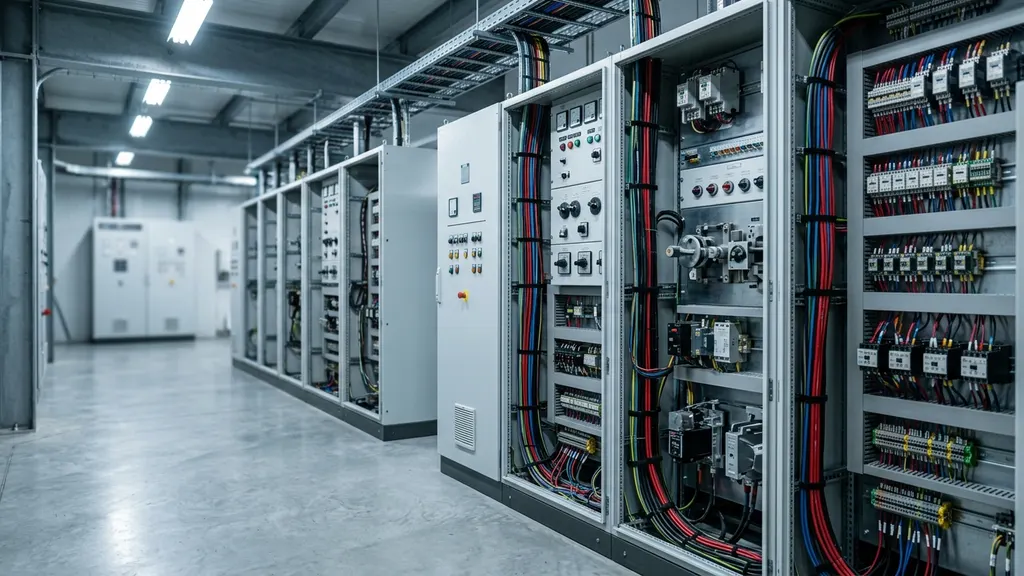
Why an IEC 61850 solar substation replaces the DNP3 collector bus
The IEC 61850 solar substation architecture displaces DNP3 over serial and DNP3 over IP because the IEC standard ties protection, SCADA, and engineering data into one self-describing logical-node model. DNP3 was point-list driven; IEC 61850 is object driven, and that distinction is what utilities care about when they specify the collector bus.
Reading the latest interconnection standards from Duke Energy, Xcel Energy, and Dominion Energy, the pattern is uniform. Every transmission-connected solar plant above 75 MVA must present an IEC 61850 server at the POI relay panel, with SCL files exchanged before energization. The IEEE 1547 revision pushed the trigger; the standards bodies followed. See the IEC 61850 standard series for the part listings.
Three drivers carry the migration:
- Engineering automation. A single SCD file describes the entire station instead of a relay-by-relay logic spreadsheet, per IEC 61850-6.
- Protection speed. GOOSE crosses the station LAN in under 4 ms, fast enough to retire most cross-trip copper, per IEC 61850-8-1.
- Vendor interoperability. The standard forces multivendor engineering, which utilities push because the maintenance tail outlasts any single relay OEM.
For a deeper view on the documentation side, see our walkthrough on commissioning the utility witness pack.
How GOOSE messages restructure protection at an IEC 61850 solar substation
GOOSE (Generic Object Oriented Substation Event) replaces hardwired trip pairs at an IEC 61850 solar substation with layer-2 multicast Ethernet frames on the station bus. Each protective relay publishes a GOOSE dataset; subscriber IEDs lock to it. The sub-4 ms transmission requirement set in IEC 61850-8-1 is what makes the replacement viable for transformer differential and POI breaker failure schemes.
A typical 100 MW interconnect carries three GOOSE publishers: the POI line relay, the GSU transformer differential, and the 34.5 kV collector main breaker. Each publishes a state-change dataset; subscribers run a virtual wire map against it. When a fault hits the POI, the trip frame reaches the GSU lockout subscriber in under 4 ms, which the IEEE Power and Energy Society documents as fast enough to preserve grid stability margins.
The hidden cost is on the test bench. A copper trip is point-to-point and visible. A GOOSE trip is a published dataset on a VLAN, and you need a sniffer with SCL awareness to confirm subscription. Without it, you can certify the publisher but never know whether the subscriber actually received it on the IEC 61850 solar substation network. On a 215 MW interconnect we commissioned near Odessa, Texas in 2024, StationScout caught a confRev mismatch on the GSU differential GOOSE block during FAT, a two-hour bench fix that would have been two days of unplanned outage at energization.
For a closer look at this, see Solar substation IEC 61850 GOOSE messaging: relay protection guide.
We cover the details separately in Solar substation transformer differential protection: IEEE C37.91 guide.
For a closer look at this, see Protection relay testing solar substation secondary injection guide.
MMS reporting versus polling for SCADA data acquisition
MMS (Manufacturing Message Specification) under IEC 61850-8-1 replaces SCADA polling with report-by-exception. Instead of the front-end processor asking each IED for analog values every second, the IED publishes a buffered report only when a deadband is crossed. The IEC 61850 solar substation gains an order-of-magnitude reduction in station bus chatter and removes the polling timestamp ambiguity that dogs DNP3 unsolicited responses.
The implementation choice is whether to run buffered or unbuffered reporting. Buffered MMS reports survive a SCADA outage by queuing on the IED; unbuffered drops on disconnect. Most utility plant specs now require buffered for analogs that feed settlement (revenue meter, POI MW/MVAR) and unbuffered for indications.
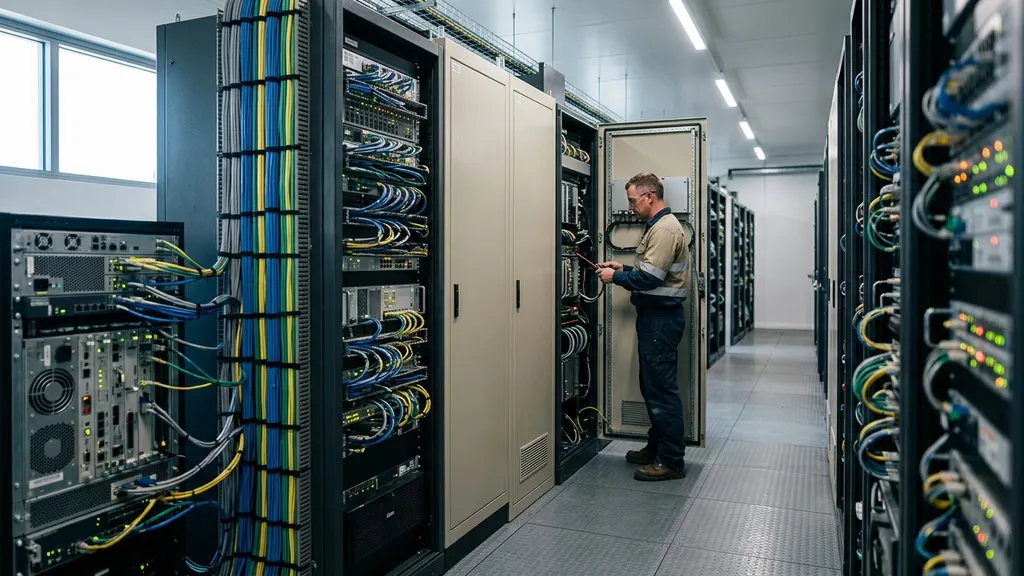
For SCADA architects coming from polled SunSpec Modbus inverter register maps, the conceptual shift is that the IED owns its data model. You discover the data set through the SCL, subscribe to reports, and stop sending read requests. The NREL grid integration program has documented the bandwidth savings on collector buses above 75 MW.
Process bus and Sampled Values in an IEC 61850 solar substation
Sampled Values (SV) under IEC 61850-9-2 push the digitization boundary all the way to the CT and PT. Instead of running secondary copper from instrument transformers to relay panels, you install a merging unit at the switchyard, sample current and voltage at 4000 Hz on a 60 Hz network, and publish the SV stream onto a process bus VLAN. Every relay subscribes.
The IEC 61850 solar substation that adopts process bus collapses the marshalling cabinet. Copper between CTs and the relay house disappears. New EHV solar plants in the Southwest are the first US sites moving on this, where copper distances at the POI substation drive the economics.
Three constraints govern adoption:
- Time. SV requires PTP (IEEE 1588) clocks to 1 microsecond on the process bus per IEEE 1588 PTP profile guidance.
- Bandwidth. A 9-2LE SV stream is roughly 5 Mbps per merging unit, so the process bus needs deterministic Ethernet, often PRP/HSR redundancy per IEC 62439-3.
- Test access. You lose the CT shorting block as a physical test point. Test sets must inject SV streams over Ethernet.
The EPRI Substation of the Future program tracks the SV adoption curve in US utility-scale solar, and the slope is still gentle because the test ecosystem trails the relay ecosystem by about three years.
SCL files: the engineering exchange for an IEC 61850 solar substation
SCL (Substation Configuration Language) under IEC 61850-6 is the XML schema that describes every IED, every logical node, every data set, every report control block, and every GOOSE subscription on the IEC 61850 solar substation network. The file extensions matter: .icd is what the vendor ships per IED type, .scd is the consolidated station file, .cid is the configured-IED file loaded back into hardware.
A clean SCL workflow looks like: collect ICDs, import into a system configurator, build the SCD with subscriptions and report control blocks, export CID files, load to IEDs, validate at FAT. The IEC 61850 standards page is the canonical reference for schema versions; new projects should land on Edition 2.1 minimum, not legacy Edition 1.
Two failure modes recur in SCADA commissioning. First, the integrator builds the SCD against an outdated ICD revision and the IED rejects the CID at load. Second, the GOOSE confRev increments silently on a vendor firmware bump and every subscriber must be rewritten. The NIST Smart Grid Framework flags SCL version drift as a top-five interoperability risk.
| Service | IEC Part | Latency / Rate | Network Layer | Primary Use |
|---|---|---|---|---|
| GOOSE | IEC 61850-8-1 | Under 4 ms | Station bus (Layer 2 multicast) | Protection trip signals and interlocks |
| MMS | IEC 61850-8-1 | Report-by-exception | Station bus (TCP/IP) | SCADA data acquisition and control |
| Sampled Values (9-2LE) | IEC 61850-9-2 | 4000 samples/sec (60 Hz grid) | Process bus (Layer 2 multicast) | CT/PT digitization via merging units |
For control architects also working on plant dispatch, see power plant controller integration.
Testing tools that validate an IEC 61850 SCL configuration
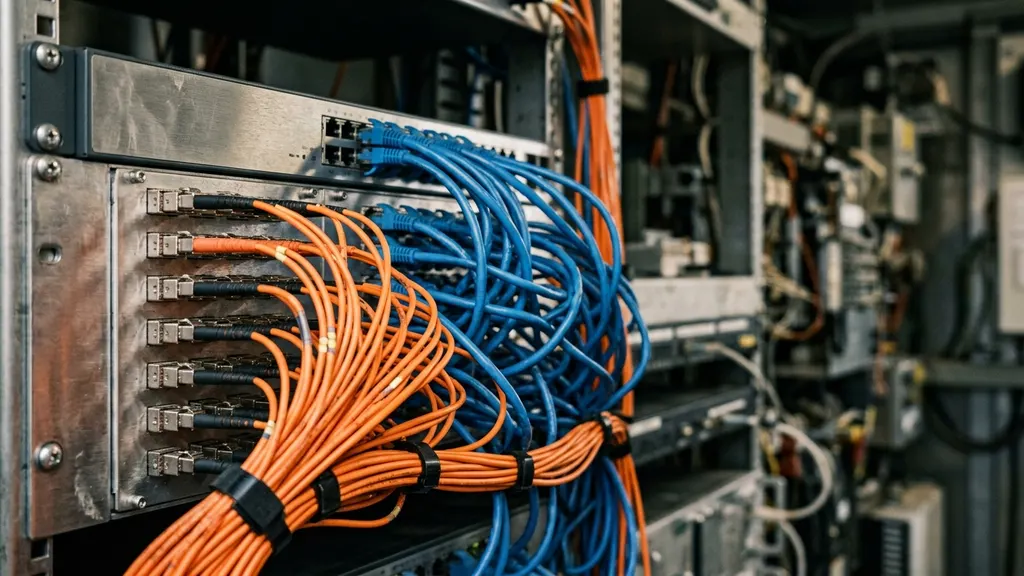
Two tool ecosystems dominate IEC 61850 site validation. Omicron StationScout reads the SCD file, builds a live subscription map from the wire-side traffic, and flags publisher-subscriber mismatches before the FAT panel closes. Doble F6150sv injects SV streams and GOOSE messages to exercise relay logic without primary current. Both run from a laptop on the station bus.
A practical commissioning sequence is StationScout for static SCL audit, then F6150sv for real-time injection, then a final passive capture during energization. Skipping the static audit is the most common cause of post-energization mystery trips, where the SCD said the subscriber was listening and the loaded CID disagreed.
Cybersecurity controls also intersect here. Test tools that touch the station bus must follow the same access posture as any IED. See our walkthrough on NERC CIP scoping for the boundary considerations, and the NERC CIP-005 standard for the formal control set. The US Department of Energy grid modernization initiative funded several of the field-validation pilots that informed the current tool generation.
Frequently asked questions
How fast is GOOSE compared to a copper trip wire?
IEC 61850-8-1 specifies sub-4 millisecond GOOSE transmission for protection-class messages, and real installations measure 1 to 3 ms end-to-end on a properly engineered station bus. A hardwired trip with auxiliary relay contacts typically sits between 8 and 20 ms, so GOOSE is two to five times faster. The IEEE Power and Energy Society documents this margin for transformer differential and breaker failure schemes. The catch is determinism: GOOSE requires a managed switch with QoS prioritization, because best-effort Ethernet can spike latency under broadcast load. Field captures from commissioned solar substation projects in the US Southwest show GOOSE delivery at 1.5 to 2.5 ms under full VLAN load when protection traffic is assigned strict priority queuing. Unmanaged switches have caused spikes above 10 ms in live plants. See IEEE PES technical reports for measured field data.
Do US utilities actually require IEC 61850 for new solar interconnects?
Yes, on the transmission-connected side. Duke Energy, Xcel Energy, and Dominion Energy publish IEC 61850 design standards for new POI substations above their respective MVA thresholds, which sit between 20 and 75 MVA depending on the utility and the BES classification. Distribution-connected plants below 20 MVA still see DNP3 collectors. The migration tracks the IEEE 1547-2018 grid-support function requirements, which utilities found easier to specify against an object-oriented model than a flat point list. The NERC BES classification review that followed FERC Order 845 pushed more solar plants above the IEC 61850 threshold than the industry expected in 2020 projections. Consult the utility-specific interconnect handbook before locking in protocols, and verify BES classification with your RTO before selecting the station bus architecture.
What is the difference between MMS reporting and DNP3 unsolicited messages?
Both are exception-based, but the data model differs. MMS reports under IEC 61850-8-1 reference a self-describing data object inside a logical node, so the SCADA front end discovers the schema from the SCL file and never hard-codes a point index. DNP3 unsolicited messages reference an integer point index from a vendor-specific list, so any IED replacement requires a point-map edit. The MMS report also carries a quality flag and a timestamp resolution that DNP3 lacks. In practice, IED replacement on a DNP3 collector bus averages two to three days of retesting and SCADA reconfiguration per relay; on an MMS-based station bus, loading the replacement IED’s ICD file and confirming subscriptions against the active SCD typically takes two to four hours. The IEC 61850-8-1 service mapping documents the full MMS behavior. The result is fewer commissioning errors and faster IED swaps.
Are Sampled Values production-ready for utility-scale solar in 2026?
Partially. The 9-2LE SV profile is mature, and merging units from SEL, GE, ABB, and Siemens have multi-year field hours on transmission. US utility-scale solar adoption is still gated by the test ecosystem and the PTP time-distribution discipline that SV demands at an IEC 61850 solar substation. EPRI tracks SV adoption in its Substation of the Future program and reports that most US PV plants commissioning in 2026 still hardwire CTs and reserve SV for the next refresh cycle. New EHV interconnects above 200 MVA are the leading edge. The primary adoption barrier is qualified PTP commissioning staff: IEEE 1588 grandmaster configuration and failover testing require skills that most EPC contractors are still building. Process bus SV pilot programs at several Western utilities are expected to produce public field reports by late 2026. See EPRI program updates for current field data.
How do I prevent SCL version drift during commissioning?
Lock the SCD baseline in version control before FAT, and demand vendor confirmation that the shipped CID matches the SCD revision number byte for byte. The NIST Smart Grid Framework flags silent confRev increments on GOOSE control blocks as a top interoperability risk. Practical controls: tag each ICD with a SHA-256 checksum at IED delivery, require vendor sign-off on every firmware revision against the active SCD, and re-run StationScout audits after any vendor patch. A real-world example: a relay firmware update from a major OEM in 2023 silently incremented the confRev on a GOOSE publisher, breaking five subscriber IEDs until the mismatch was identified. The NIST reference architecture for substation automation lays out the change-control discipline. The cost of catching SCL drift at FAT is hours; catching it at energization is days of outage.
What goes in the witness pack for an IEC 61850 commissioning?
The utility wants four artifacts: the signed SCD with all IED subscriptions documented, the StationScout audit report showing zero subscription gaps, the GOOSE and MMS real-time injection results from a test set such as Doble F6150sv, and the energization capture proving live publish-subscribe behavior. Add the time-synchronization audit covering PTP grandmaster failover and IRIG-B redundancy for any plant with process bus. For process bus plants, the grandmaster failover test should document switchover time; utilities typically require below 50 ms for non-protection functions. The four-artifact pack is the baseline expectation for any transmission-tied plant seeking energization authorization from Duke Energy, Xcel Energy, or Dominion Energy under their current IEC 61850 design standards. See NREL grid integration documentation for sample acceptance criteria used on federal-funded projects.