
Solar panel soiling loss measurement: methods and cleaning ROI
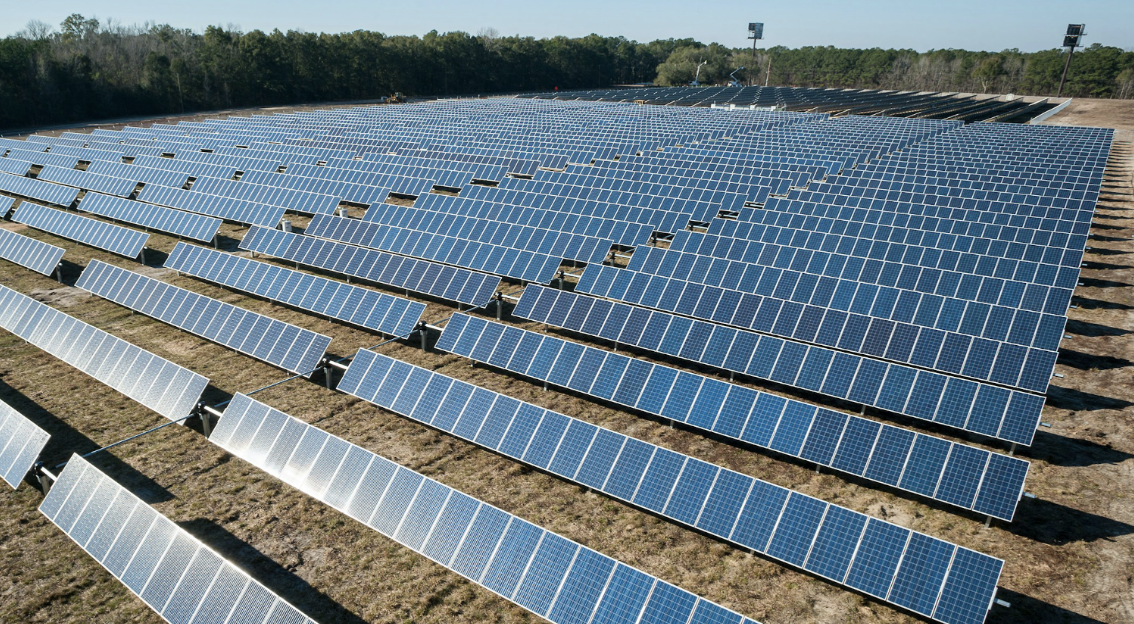
NREL field data shows arid utility-scale sites lose 5-7% of annual energy yield to soiling in dry seasons alone, translating to hundreds of thousands of dollars per 100 MW at typical PPA rates. Yet many plants still rely on visual inspection instead of instrumented data. A defensible solar panel soiling loss measurement program pairs IEC 61724-1 sensors with SCADA integration and a ROI-driven cleaning schedule that pays back within a season.
Solar panel soiling loss measurement fundamentals under IEC 61724-1
Solar panel soiling loss measurement is the practice of quantifying, at operating conditions, the fraction of expected DC energy blocked by accumulated dust, pollen, salt, ash, or bird droppings on module surfaces. Utility-scale plants adopt this practice not for academic curiosity but to defend PPA availability commitments and to schedule cleaning against real revenue math rather than calendar habit.
The reference document is IEC 61724-1:2021, published by the International Electrotechnical Commission. It defines the soiling ratio (SR) as the ratio of the short-circuit current of a soiled PV module or reference cell to the short-circuit current of an identical clean reference module or cell, measured simultaneously under the same irradiance and cell temperature. See the standard summary at iec.ch. A soiled reference producing 5% less current than the clean pair yields SR = 0.95, indicating a 5% instantaneous soiling loss.
Two conditions matter. First, temperature correction: soiling ratio requires temperature-normalized short-circuit current, because module current is sensitive to cell temperature at high irradiance. Second, filtered data windows: SR should be computed only when plane-of-array irradiance exceeds 500 W/m² and both sensors are within a defined delta of angle of incidence. The NREL PV soiling research program publishes reference algorithms used by most integrators when writing SCADA soiling logic.
Sensor selection for solar panel soiling loss measurement
Field-grade solar panel soiling loss measurement uses one of three sensor architectures. Each has a different accuracy floor, capital cost, and O&M burden. Choose based on climate class, plant size, and how tightly the O&M team will act on the data.
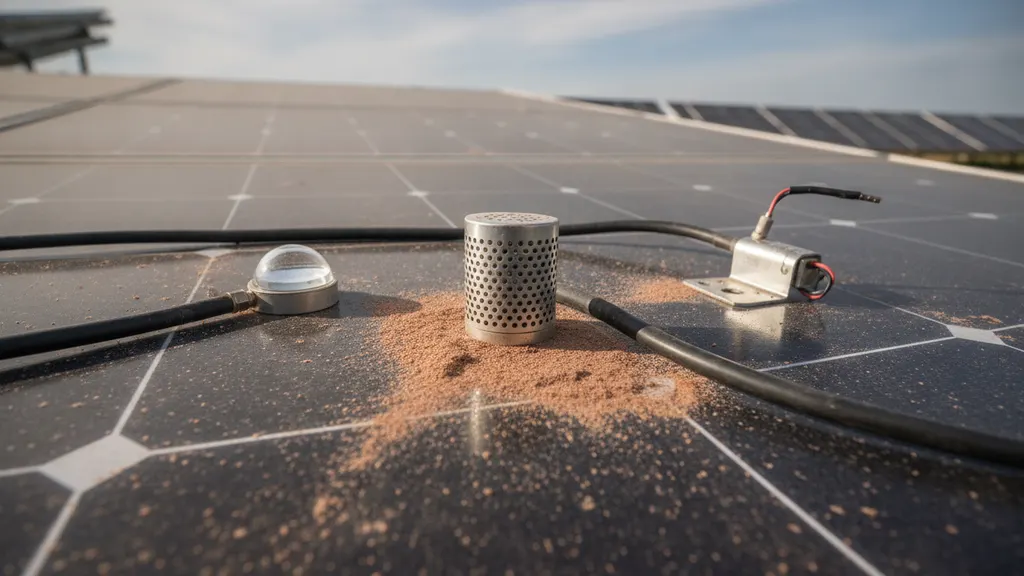
Dual reference cell soiling stations pair a naturally soiled reference cell with a routinely cleaned twin. A ratio of the two short-circuit currents produces SR directly. This is the simplest architecture and the one benchmarked in NREL and IRENA solar technology field studies. Accuracy is typically within ±0.5% SR when cleaning cadence for the reference is disciplined.
Full-module reference tables mount two identical PV modules on a small structure, wired to independent DC current measurement. This eliminates cell-to-module scaling errors and is preferred for high-value plants above 100 MW.
Optical soiling sensors use a transparent glass witness plate with photodiodes above and below to track light transmission. They are lower cost and lower maintenance, but they only track transmission through the coupon glass, not electrical performance of the modules themselves. Cross-check optical sensors against a reference cell station at commissioning; the two often diverge by 1-2% in mineral dust environments.
Deployment density from IEC 61724-1: for Class A performance monitoring, plan at least two soiling measurement locations for every 20 MW AC block, with additional stations at sites with terrain-driven microclimate variance. See our met station sensor selection guide for how these devices integrate with pyranometers and back-of-module temperature sensors.
Building the ROI case for solar panel soiling loss measurement
A 100 MW AC plant at 25% capacity factor and a $35 per MWh PPA loses approximately 2,190 MWh and $76,000 in revenue for every 1% of soiling, per SEIA energy yield modeling. Solar panel soiling loss measurement converts that ratio into a daily cleaning trigger rather than a quarterly budget surprise.
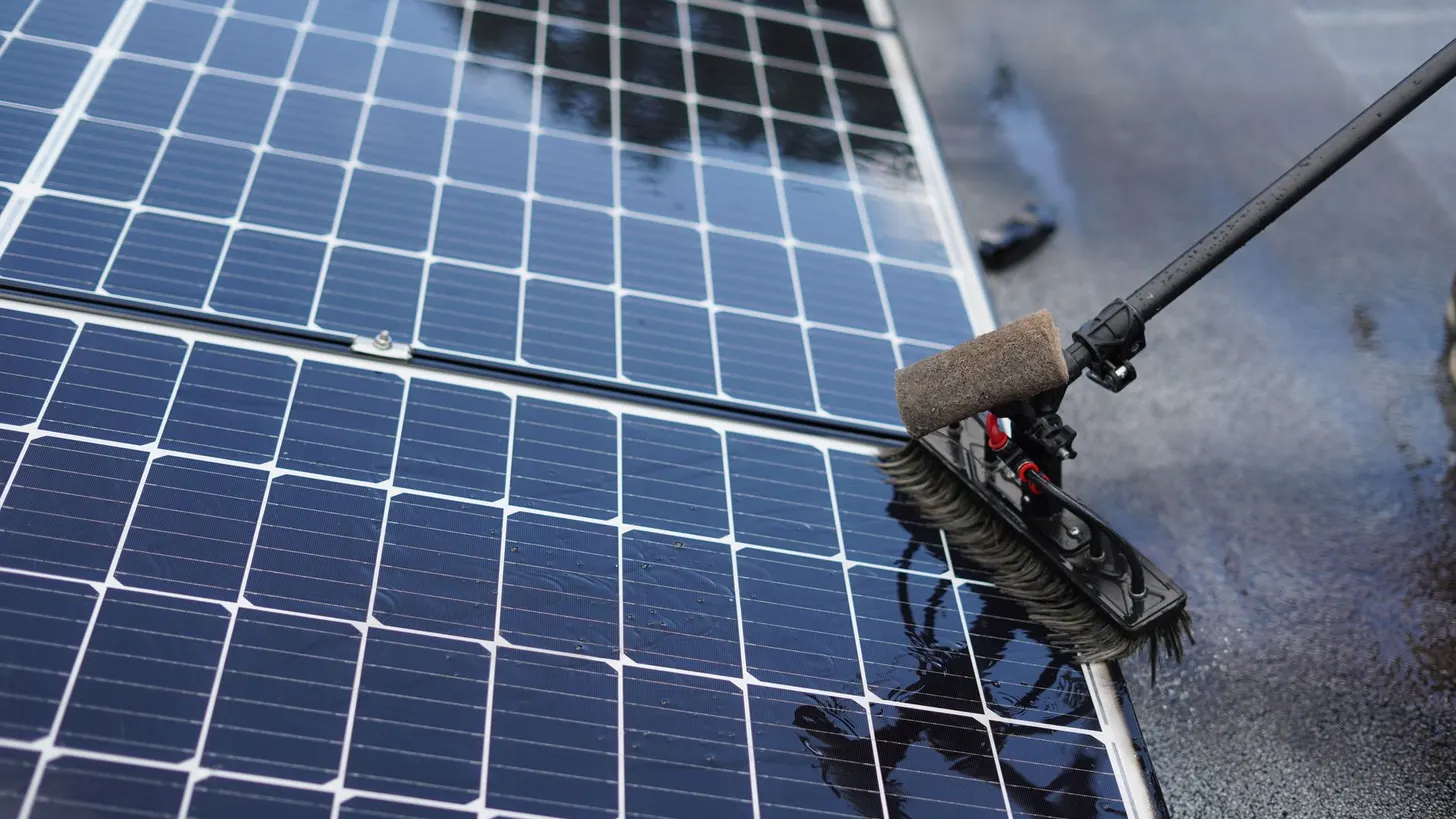
For a Southwest plant losing 6% annually on those same PPA economics, the revenue at risk approaches $460,000 per year. Cleaning capex must be sized against that recoverable revenue. Cost per cleaning cycle varies with method: dry brushing is typically the lowest cost per kW, pressurized deionized water systems run materially higher, and robotic dry-cleaners carry heavier capex amortized over multi-year horizons, per EPRI soiling economics reviews.
Data-triggered cleaning improves the math clearly. A study cited by the DOE Office of Energy Efficiency and Renewable Energy found that soiling-ratio-triggered cleaning captures the majority of preventable soiling losses with roughly half the cleaning cycles versus a fixed monthly schedule. That is the core economic argument for instrumenting soiling rather than scheduling by calendar.
On a 152 MW AC plant REIG commissioned in Maricopa County, Arizona in 2024, our reference cell stations recorded a peak-summer soiling ratio of 0.91 after six consecutive weeks without precipitation. Comparing that SR against the plant’s $38 per MWh PPA showed over $390,000 in annualized revenue exposure. Switching from a bi-monthly calendar schedule to threshold-triggered cleaning reduced cycle count by 40% while recovering SR to 0.995 within 48 hours of each cleaning event, paying back the sensor and SCADA instrumentation cost within the first operating season.
Matching cleaning methods to soiling profiles and water availability
Cleaning method selection is a function of soiling type, water availability, module warranty terms, and labor market. Solar panel soiling loss measurement data drives the choice by revealing whether soiling accumulates uniformly (favoring dry cleaning) or unevenly with bird deposit or salt spray (favoring water). Sites with heavy inorganic dust in low-water regions increasingly deploy dry robotic cleaners; sites with pollen, salt, or bird deposit contamination need water.
| Cleaning method | Best fit | Relative cost profile | Water use |
|---|---|---|---|
| Manual brushing | Light dust, small blocks | Low opex, high labor | Low |
| Truck-mounted pressurized water | Heavy soiling, pollen, salt | Higher opex, medium labor | High |
| Robotic dry cleaner | Arid sites, tracker rows | Capex-heavy, low opex | None |
| Fixed spray rails | Bird belt sites | Capex-heavy, low opex | Moderate |
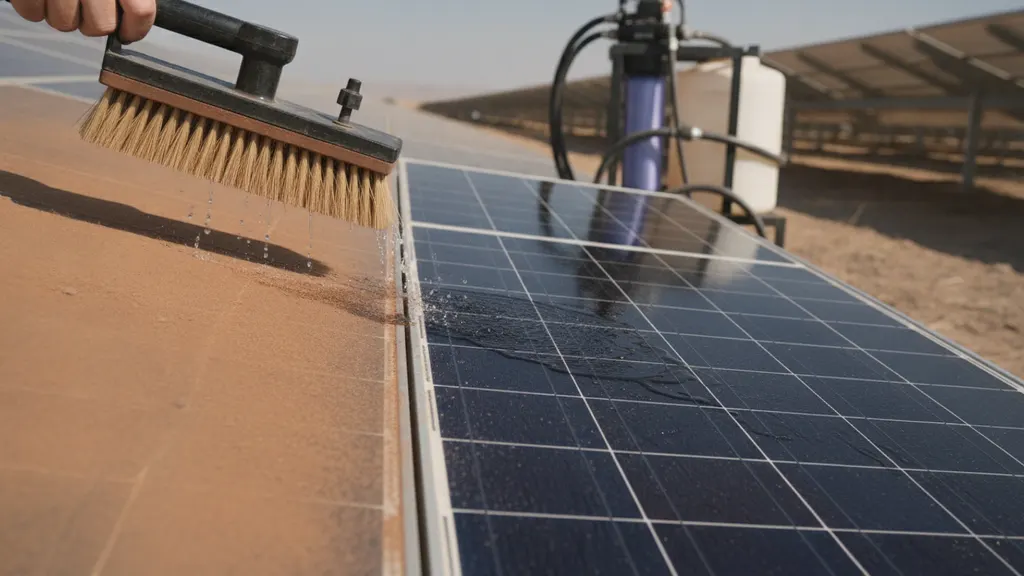
EPRI soiling research has published module-agnostic guidance that aggressive dry cleaning may cause abrasive damage on some anti-reflective coatings, particularly in mixed-mineral dust environments. Coordinate cleaning method with module manufacturer warranty terms before writing cleaning specifications, and document the accepted method in the O&M plan handed to any subcontractor.
Solar panel soiling loss measurement in SCADA dashboards and O&M reports
Solar panel soiling loss measurement should feed at least three downstream systems: the plant SCADA dashboard, the monthly O&M performance report, and the cleaning work-order engine. Data trapped in a sensor without SCADA integration is worth nothing on the balance sheet, because it cannot trigger action or defend cleaning capex to owners.
Tag design for SCADA integration: at minimum, publish instantaneous SR, filtered daily average SR, and cumulative energy loss since last cleaning as three separate tags per soiling station. Publish reference cell temperature and irradiance separately so performance analysts can reproduce the SR calculation manually. See our performance ratio guide for how soiling loss feeds into the IEC 61724-3 PR calculation used in PPA reporting.
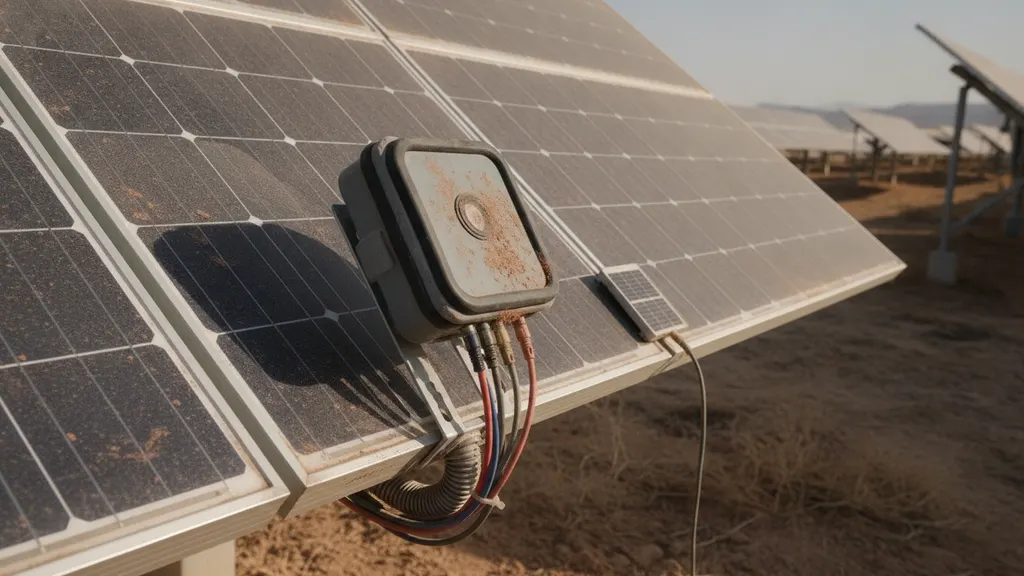
Monthly performance reports for O&M contracts increasingly separate soiling loss from other underperformance factors. Reporting soiling as a discrete deduction against expected energy improves availability negotiation with asset owners. Cross-reference NREL LCOE cost breakdowns to argue for cleaning capex in front of asset managers who need to see the recoverable revenue quantified.
Alarm thresholds: two configurable thresholds are common. First, a soiling ratio below 0.98 sustained for seven days generates a low-priority alarm. Second, SR below 0.95 sustained for three days generates a work-order alarm through the CMMS. Our SCADA alarm rules guide covers how to tune these thresholds against nuisance alarm rate on large plants.
Data quality assurance is the last piece. Independent audit of soiling data against known reference conditions, as described by IEEE PV performance standards working groups, protects against slow drift in reference cell calibration. Reference cells should be re-calibrated on an 18-24 month cadence. Document the audit trail in the plant O&M binder so PPA availability disputes have a defensible technical record behind them.
Frequently asked questions
How often should a utility-scale plant recalibrate soiling reference cells?
Reference cells used for solar panel soiling loss measurement should be re-calibrated against a laboratory-grade reference on an 18-24 month cadence, or sooner if soiling ratio data drifts against the fleet baseline. A cell that drifts 0.5% below true response will systematically underreport soiling, giving false confidence that a plant is performing within threshold. The IEA PVPS task reports and NREL publish reference cell calibration procedures. On plants above 100 MW, most O&M organizations rotate one reference cell out per quarter for lab calibration, which keeps the fleet within tolerance without ever removing all measurement capability from the plant at the same time.
What soiling threshold should trigger a cleaning work order?
The defensible threshold depends on PPA rate, cleaning cost, and expected recovery. A common rule for U.S. Southwest plants at $30-40 per MWh PPA is to trigger cleaning when the seven-day rolling soiling ratio drops below 0.97, corresponding to about a 3% loss. Sites with lower cleaning cost or higher PPA rates trigger sooner. Frameworks from SEIA yield modeling let O&M teams derive a plant-specific breakeven that supersedes generic industry rules of thumb across the fleet.
Do optical soiling sensors replace reference cells?
Optical soiling sensors are useful for early warning and low-cost density, but they should not fully replace reference cells for solar panel soiling loss measurement at utility-scale. Optical sensors track light transmission through a glass witness plate, not electrical performance of the module string, and can diverge by 1-2% from a reference cell station in dust environments. IEC 61724-1 Class A monitoring assumes electrical-current-based measurement. Pair optical sensors as low-cost density fill between reference cell stations, and cross-validate at commissioning against a co-located dual reference cell rig.
How does soiling loss interact with PPA availability guarantees?
Most PPA availability clauses are written against energy delivered, not energy available, which means soiling reduces payments to the owner unless the O&M contract explicitly carves out soiling as a controllable loss. On a 100 MW plant at $35 per MWh, a sustained 4% soiling loss over 90 days removes roughly $85,000 from energy delivery, which can exceed the annual liquidated-damage threshold in tightly written PPA availability riders. Instrumenting soiling ratio gives owners the data to defend cleaning capex against those damages. FERC Order 2222 and adjacent rulings have raised the value of predictable energy delivery from distributed resources, which sharpens the case for data-driven cleaning schedules on plants with tight availability commitments.
Can drone thermal imaging detect soiling loss?
Drone thermal imaging can flag heavy localized soiling that produces cell-level temperature anomalies, but it is not a substitute for a soiling ratio measurement program. Uniform soiling across a module produces very little thermal signature because current is reduced uniformly across strings. Drone inspection complements a reference-cell based program by finding localized bird deposit or debris hotspots that uniform sensors miss. A reference-cell station offline for maintenance can mask plant-wide soiling accumulation that the drone would not detect, which is why the two programs must be tracked in parallel rather than as independent data streams. See our drone thermal inspection guide for how both data streams integrate in O&M workflows.
How does soiling measurement fit into IEC 61724-3 performance ratio calculation?
IEC 61724-3 performance ratio can be reported with or without a soiling loss carve-out. Reporting soiling-corrected PR alongside raw PR separates cleanable underperformance from tracker misalignment, inverter clipping, and grid curtailment. Asset managers increasingly require soiling-corrected PR in monthly reports because raw PR conflates cleaning decisions with hardware underperformance, and separating the two clarifies which budget line resolves the gap. Published methodology from NIST photovoltaic measurement work supports carve-out reporting. Most modern monthly reports include both PR figures side by side so solar panel soiling loss measurement drives the conversation with owners.