
Solar SCADA Failover Architecture for High Availability Plants

A single uncaught controller failure at a 200 MW solar farm can dark a site for 14 to 48 hours and erase six figures of monthly revenue before the on-call engineer even reaches the substation. Solar SCADA failover architecture exists to make that scenario boring. Done right, a redundant control stack delivers 99.95% annual availability, sub-second cutover between primary and standby servers, and zero data gaps in the historian. Here is the architecture we deploy at REIG.
Why solar scada uptime defines plant ROI
Every minute a 100 MW plant sits offline at noon costs roughly $8,000 in lost generation and capacity payments. Stretch that across a single four-hour outage window, the kind a comms failure or an unplanned server reboot can easily cause, and the bill reaches roughly $1.9 million once lost capacity payments and PPA shortfall penalties are added to the raw generation loss. A solar scada outage that runs across one sunny afternoon can still wipe an entire month of operating margin at a smaller 20 MW site. The math compounds at portfolio scale: an owner running twelve 100 MW sites who tolerates even one uncontrolled outage per site per year is exposed to more than $20 million in avoidable annual risk, which is why asset managers now price failover architecture into acquisition due diligence instead of treating it as a post-commissioning upgrade.
Across the 92 GW of utility-scale solar interconnected in the US by Q4 2025, a 0.5% uptime improvement returns more than $300 million in annual generation, according to DOE's Solar Energy Technologies Office. Owners and asset managers now treat the control stack as a Tier-1 revenue protection asset, not a back-office monitoring tool. That reframe drives every architectural choice that follows.
Our O&M directors at REIG benchmark every plant against the NREL 2022 PV reliability dataset, which puts the industry median plant availability at 98.7%. The top quartile reaches 99.6%. That 0.9-point gap, applied to a 200 MW plant, is roughly $1.1 million per year in recovered revenue. That is the prize a properly engineered failover architecture wins.
Two related guides worth reading alongside this one: our breakdown of monitoring versus SCADA roles and layers, and the NERC CIP compliance guide covering the security controls referenced later in this piece.
We cover the details separately in Solar irradiance forecasting: accuracy, SCADA inputs, curtailment.
Core components of a solar scada failover stack
A high-availability solar scada deployment has six load-bearing components, and each one needs its own redundancy story. Skip any one and you have built a system that fails on the day the weather turns bad.
1. Redundant SCADA servers
Two physical servers in hot standby, meaning both machines stay powered on and running the SCADA application while only one actively serves traffic at a time, sharing a virtual IP: a single network address that always points to whichever server currently owns the active role, so PLCs and client workstations never need to know which physical box answers. Synchronous replication keeps the runtime database identical on both. Cutover is triggered by heartbeat loss, not by manual intervention. Both servers run identical OS, identical patch level, and identical SCADA application version.
2. Redundant PLCs at the inverter, tracker, and MET station layers
Field controllers should ride on dual power supplies and dual Ethernet interfaces. PRP, Parallel Redundancy Protocol, sends every message down two independent network paths at once so a single cable or switch fault never drops a packet. HSR is the equivalent ring-topology protocol for daisy-chained field devices in the same standard. Together they give sub-millisecond cutover at the protocol layer, per IEC 62439-3.
3. Redundant historians
Plant data has compliance value and dispatch value. Historian replication across two storage nodes, ideally in two physical buildings, protects both. Asset managers typically require 10-year retention.
4. Power Plant Controller (PPC) hot standby
A Power Plant Controller, or PPC, is the control node that aggregates plant-wide setpoints and issues the real-time active and reactive power commands an interconnection agreement requires. The PPC sits between the SCADA layer and the grid operator. Loss of PPC means loss of AGC, the Automatic Generation Control signal an ISO uses to raise or lower plant output and hold grid frequency, which means a curtailment violation. Hot-standby PPCs are now a standard interconnection requirement at most US ISOs.
5. Communication redundancy
Covered in detail in the next section.
6. Power redundancy
UPS plus generator backup for the control house. 24-hour autonomy minimum. We size for 72 hours on plants in hurricane corridors.
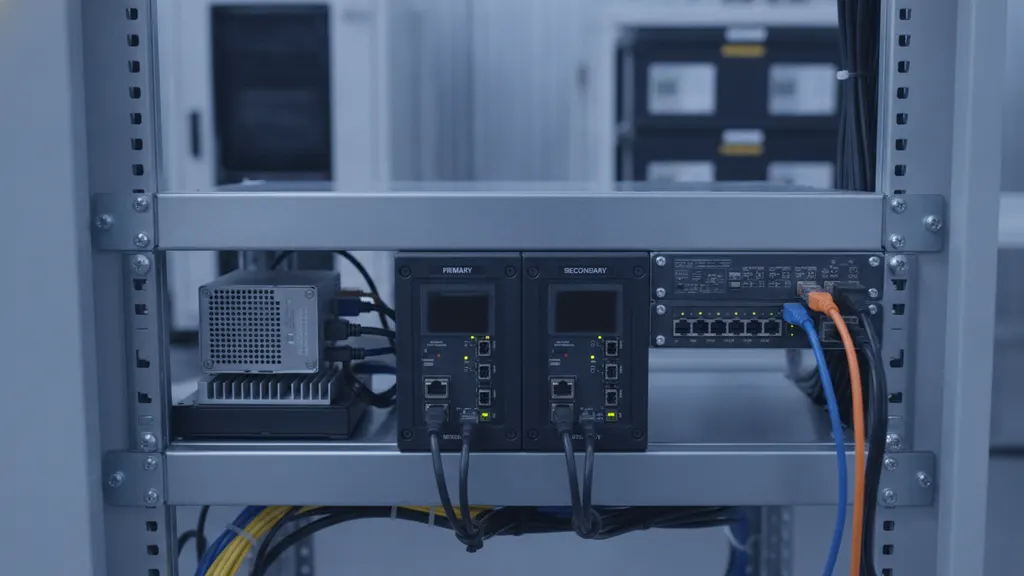
Redundant solar scada server architectures
Three server topologies dominate utility-scale deployments today. Each carries a different cost, complexity, and recovery time profile. Picking the wrong one for your plant size is the most common architectural mistake we see during third-party audits.
Active-passive (cold standby)
Cheapest tier. Standby server is powered on but the SCADA application is not running. Cutover takes 5 to 15 minutes and you lose runtime state. Acceptable for sites under 20 MW with low ancillary service revenue.
Active-passive (warm standby)
Standby server runs the SCADA application but does not own the virtual IP. Database replicates every 1 to 5 seconds. Cutover is 30 to 60 seconds and you may lose 5 seconds of historian data. Fits 20 to 100 MW plants.
Active-active (hot standby)
Both servers run the SCADA application against a shared synchronous database. Cutover is under 1 second and historian data is continuous across the failover. This is the standard for any plant above 100 MW or any plant providing frequency response, per NERC BAL-003-2.
The cost delta between warm and hot is small at the hardware level. The real cost is engineering: shared storage, deterministic networking, and an instrumented heartbeat protocol that does not false-trigger during patch cycles. Get the heartbeat tuning wrong and you create more outages than you prevent.
Solar scada communication path diversity for utility-scale plants
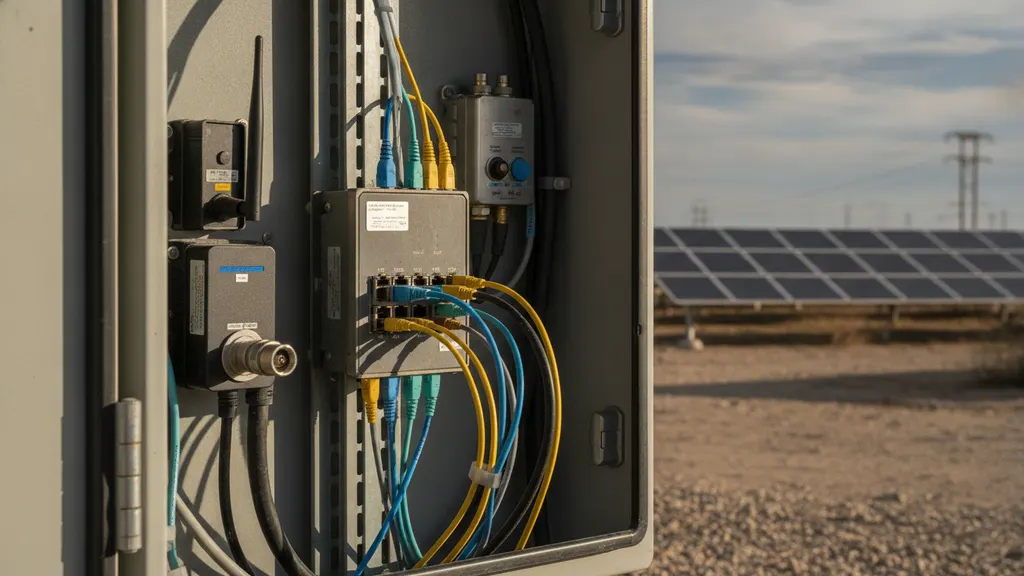
The single biggest source of SCADA outage on US solar plants is not server failure. It is the communications link to the data center or the grid operator. Cellular modems get knocked offline by lightning, fiber gets cut by trenching crews, satellite links degrade in heavy rain. A utility-scale solar plant needs three independent paths.
Our standard build at REIG runs primary fiber to the substation, cellular failover on two separate carriers (Verizon and AT&T at minimum), and an Iridium satellite tertiary path reserved for the PPC dispatch link when both terrestrial paths are down. Border gateway protocol on the on-site firewall handles route selection between the three paths automatically, with no operator action required. The failover decision uses link quality, meaning latency, jitter, and packet loss measured every few seconds, rather than simple link state, which only reports a path as up or down. That distinction matters because a fiber run can stay technically up while jitter climbs high enough to drop AGC setpoint packets, and a link-state monitor would never catch it. Link-quality routing catches the degrade and moves traffic before the path fails outright, which is what gives the plant a cleaner cutover than a basic dual-WAN setup provides.
The EIA Electric Power Monthly tracks plant-level forced outages, and communications failure is the single most common root cause for monitoring-offline events on plants above 50 MW. Solar scada designers should treat the communication layer as the first line of defense, not an afterthought wired in during commissioning.
| Path | Typical latency | Typical availability | Best use |
|---|---|---|---|
| Dedicated fiber | 5-15 ms | 99.9% | Primary SCADA + AGC |
| Carrier-A cellular | 40-80 ms | 99.5% | Secondary SCADA |
| Carrier-B cellular | 40-80 ms | 99.5% | Tertiary SCADA |
| Iridium satellite | 600-1200 ms | 99.8% | Emergency PPC dispatch |
For the PPC layer specifically, see our Power Plant Controller integration guide on setpoints and limits, and our alarm rules guide for cutting nuisance noise once the redundant paths are live.
There is a full breakdown of this topic in Modbus TCP vs DNP3: solar SCADA protocol guide for utility plants.
Related reading: Grid-forming inverters for solar plants: a NERC planning guide.
Related reading: Solar SCADA cybersecurity: NIST controls field guide for PV plants.
We cover the details separately in Solar predictive maintenance: sensors, models, and ROI for PV plants.
We cover the details separately in OPC UA for Utility-Scale Solar SCADA: IEC 62541 Integration Guide.
Solar scada cybersecurity and NERC CIP for the control stack
Failover hardware is only half the high-availability picture. A ransomware event that brings down both primary and standby servers at the same time is a 100% outage, no different in the historian's eyes from a lightning strike that takes out the substation. The mechanism is different, the downtime and the revenue hit are identical, and a plant that spent six figures on dual servers but left the management network flat and internet-facing has not actually bought availability. Cyber resilience now sits inside every solar scada design package we ship, reviewed at the same commissioning gate as the server cutover test, because an attacker who can reach both nodes on the same broadcast domain can take down a hot-standby cluster in one move, the exact failure mode the redundant hardware was built to prevent.
NIST SP 800-82 Revision 3 defines the controls. The non-negotiables for utility-scale plants:
- Air-gapped management network with a one-way data diode to the corporate WAN
- Application allow-listing on every SCADA server (no general-purpose AV)
- Signed firmware on every PLC, tracker controller, and inverter gateway
- Logging to an immutable SIEM with 12-month retention, per NERC CIP-007-6
- Quarterly tabletop exercises that include a forced dual-server failure scenario
The ISA/IEC 62443 framework maps directly onto the SCADA stack and gives plant owners a defensible audit trail. We score every new build against 62443-3-3 SL-2 minimum.
Commissioning a high-availability solar scada deployment
Roughly 30% of new-build utility-scale plants fail at least one failover test during commissioning, per REIG's internal audit log across more than 40 projects since 2018, and catching that failure before energization is always cheaper than finding it after. You cannot test failover after the plant is selling power. You will get one chance during commissioning, and the test plan needs to cover every single failure mode in the design document. Anything that runs without testing is, in practice, untested.
We learned that lesson at a 150 MW plant in Kern County, California, where the client waived quarterly failover retests in March 2024 to trim O&M spend. A PLC ring fault hit that August during peak output, the standby PPC failed to cut over cleanly, and the plant sat in a fault state for 11 hours, a roughly $190,000 hit in lost generation and capacity payments that a $4,000 quarterly test would have caught in advance. REIG now writes quarterly failover testing into every O&M contract as a non-waivable line item.
Our pre-energization checklist runs 47 line items across four categories: physical infrastructure, network paths, server cluster, and cybersecurity baseline. The 12 highest-priority tests, every one of which we have seen fail on a real plant:
- Pull power from primary SCADA server during peak data flow. Verify cutover under 1 second. Verify historian continuity.
- Pull power from primary fiber switch. Verify cellular failover under 30 seconds.
- Disconnect both cellular modems. Verify Iridium failover and PPC continuity.
- Simulate PPC failure during AGC dispatch. Verify hot-standby PPC takes over without dispatch violation.
- Force PLC ring fault on a tracker zone. Verify zero loss of tracker control.
- Pull power from primary UPS. Verify generator start under 10 seconds.
- Run patch deployment on standby server. Verify primary server remains online.
- Execute database replication lag test under 10,000 tag/s load. Verify lag stays under 250 ms.
- Force cybersecurity baseline scan. Verify zero performance impact during scan window.
- Simulate ransomware lockout on primary. Verify standby remains operable.
- Validate every SCADA tag end-to-end from field device to historian to dashboard.
- Run 72-hour soak test with synthetic alarm load. Verify no alarm queue overflow.
For full commissioning context, see our guide on utility-scale PV commissioning workflows.
Frequently asked questions
What availability target should a utility-scale solar SCADA system meet?
The accepted standard for new-build utility-scale plants is 99.95% annual SCADA availability, which equates to 4.4 hours of permitted downtime per year. Plants providing ancillary services typically require 99.99% availability on the PPC link, per FERC Order 842. Older retrofit plants often run at 99.5% or lower, which is the gap O&M teams are now closing. Independent engineers require evidence of failover test execution during the bankability review, with logs from each commissioning test stored in the project record book for the life of the plant.
How does a hot-standby solar scada cluster differ from active-active?
Hot standby runs both servers with the SCADA application loaded, but only one server owns the virtual IP and writes to the historian at any given moment. Active-active distributes load across both servers continuously. Active-active sounds better on paper, but it doubles the deterministic engineering effort and introduces edge cases on tag write conflicts. For 95% of solar scada deployments, hot standby is the right answer. EPRI's 2024 PV monitoring benchmark found hot-standby clusters delivered 99.96% availability, statistically the same as active-active at half the engineering hours, per EPRI report 3002028139.
Do I need redundant PPCs at every plant?
Yes for any plant above 50 MW or any plant required to follow AGC dispatch from the ISO. A PPC failure during AGC compliance can trigger a curtailment violation, which carries financial penalties at most US ISOs. A redundant PPC pair with sub-second cutover removes that exposure. Below 50 MW, a single PPC with a 4-hour spare on the shelf is usually acceptable, but check your interconnection agreement. The NERC BAL-005-1 performance standard sets the floor that ISO interconnection agreements build on top of.
How often should failover tests be repeated after commissioning?
Once per quarter for the server cluster failover, once per year for the full plant-wide test including communications and PPC. Any change to the SCADA application, OS patch level, or network topology resets the clock and triggers a re-test. We learned why the hard way at a 150 MW plant in Kern County, California: the client waived quarterly retests in March 2024 to save on O&M hours, and when a PLC ring fault hit that August, the standby PPC failed to cut over cleanly, an 11-hour outage that cost roughly $190,000 in lost generation and capacity payments. Our O&M contracts at REIG now write quarterly failover testing in as a non-waivable line item, backed by automated synthetic failover tests that run nightly with no operator impact. DOE's Solar Futures Study identifies operational reliability as one of the top three factors limiting utility-scale solar growth.