
Solar farm arc flash risk assessment: OSHA utility-scale guide
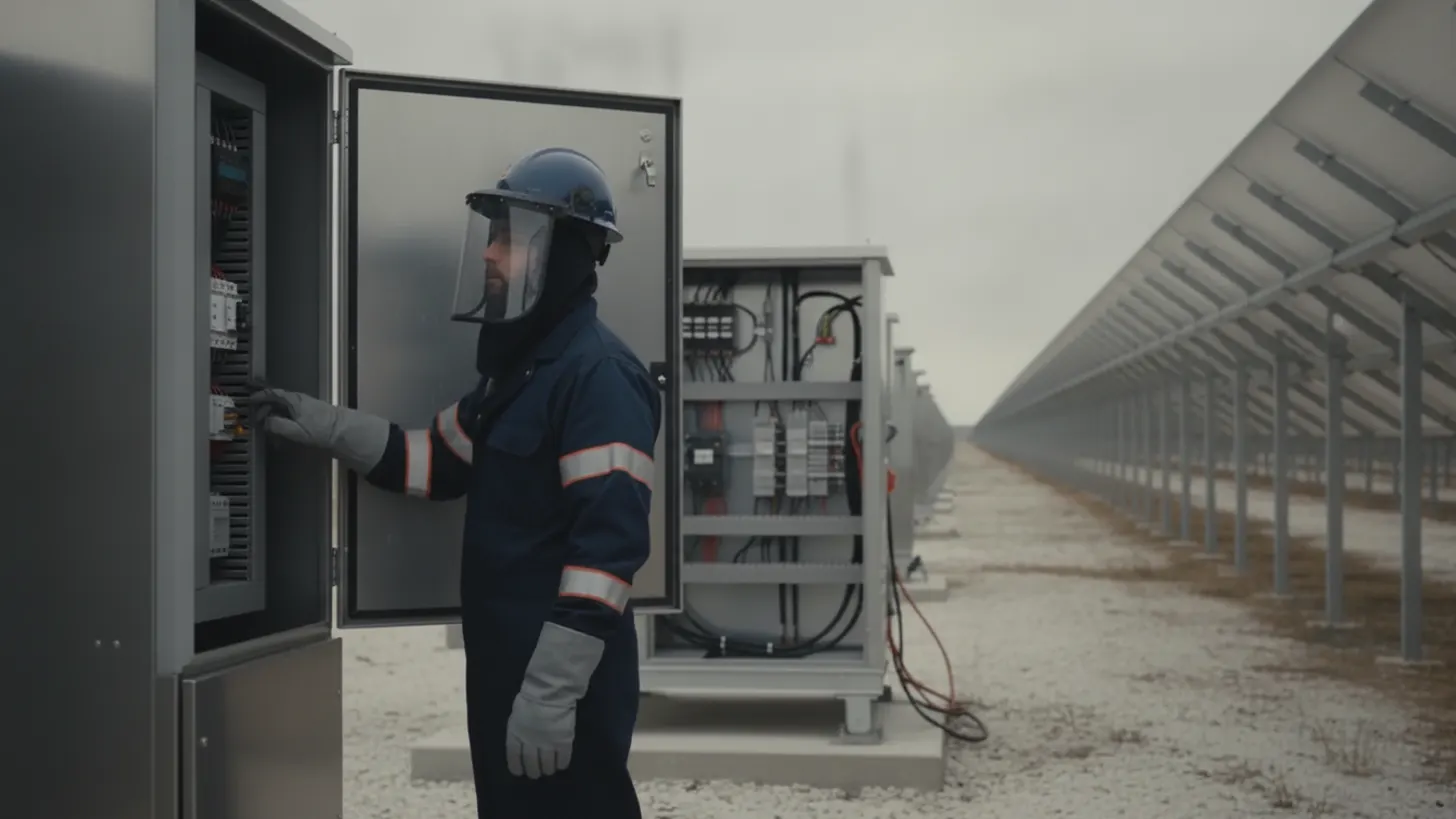
OSHA's own guidance for solar energy workers lists electrocution and arc flash among the hazards that kill, and the exposure does not live in the array: it lives in the 34.5 kV collection system, the inverter skids, and the medium-voltage switchgear an O&M tech opens at 2 a.m. A solar farm arc flash risk assessment puts a calculated incident-energy number on each of those points, using IEEE 1584-2018, so PPE and work methods stop being guesswork.
Where a solar farm arc flash risk assessment finds the highest risk
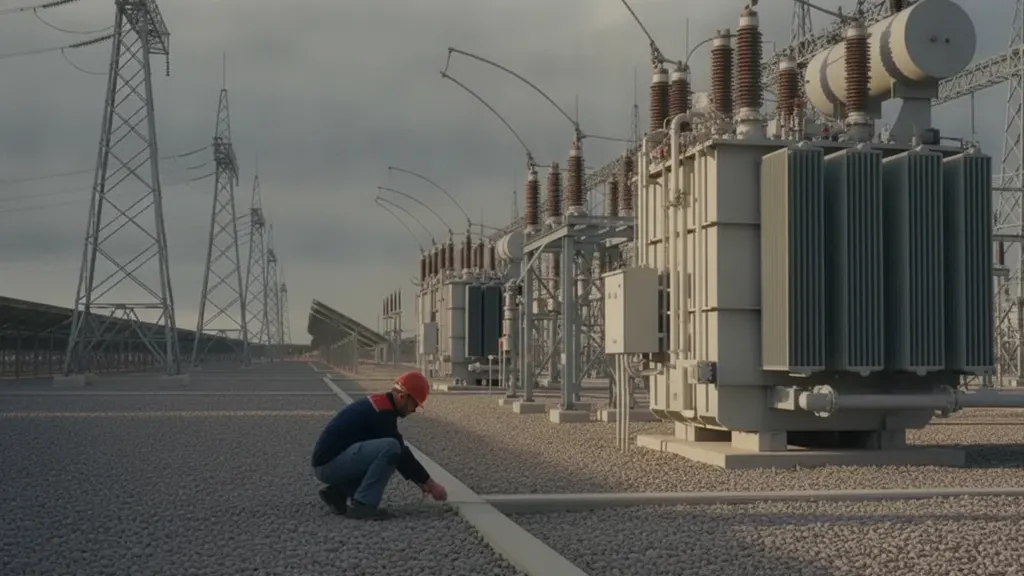
The highest incident energy on a PV site sits upstream of the inverters. Medium-voltage collection switchgear, pad-mount load-break cabinets, the main power transformer secondary, and the station service panel feeding tracker controllers all see utility-side fault current. The DC array is hazardous for different physics, so a solar farm arc flash risk assessment has to treat the two domains separately.
On the AC side, available fault current comes from the utility interconnection and the main power transformer impedance, while clearing time comes from the relay settings in the collection substation. Slow-clearing devices are the real problem: a 480 V station service breaker riding an inverse-time element can hold an arc long enough to deliver more energy than a medium-voltage bus that clears in a few cycles. Breaker failure protection testing matters here, because a stuck breaker converts a fast fault into a backup-cleared fault and multiplies the exposure at the working distance.
On the DC side there is no current zero helping the arc extinguish, and string current is bounded by irradiance rather than by source impedance. OSHA's solar energy worker hazard guidance groups electrocution and arc flash together for exactly this reason. DC faults in combiner and recombiner enclosures are also harder to detect from the plant controller, which is why string combiner overcurrent design carries so much of the safety burden on the array side, as the Solar Energy Technologies Office reliability work reflects.
Field data behind a solar farm arc flash risk assessment
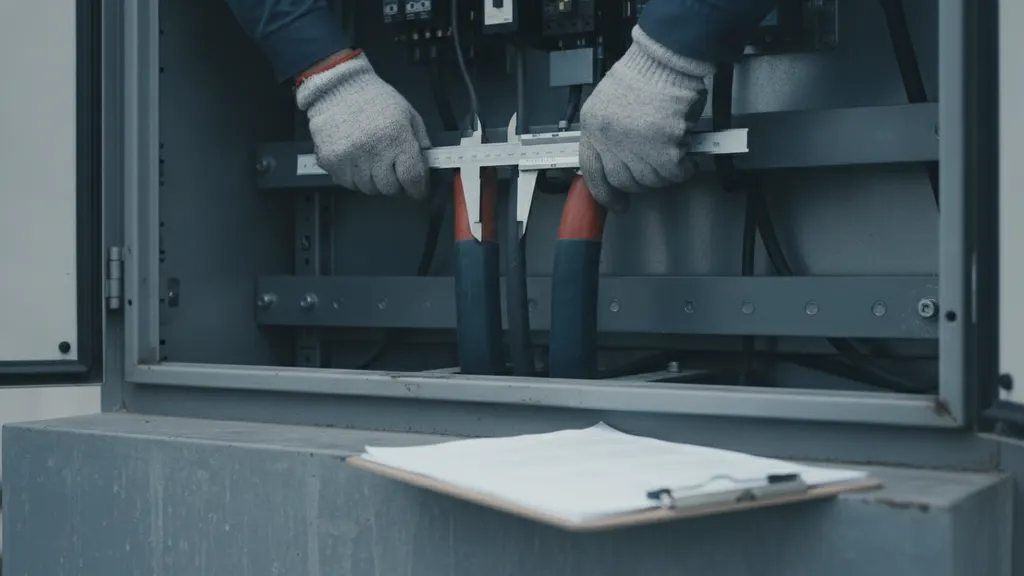
A study is only as good as the data behind it. Before modeling begins, the engineer needs the utility available fault current and X/R ratio, transformer nameplate impedances, conductor sizes and lengths, the make, model, and as-left settings of every protective device, and enclosure dimensions for each equipment class.
Enclosure geometry drives the result more than most owners expect. IEEE 1584-2018 replaced the single box model with named electrode configurations, so a solar farm arc flash risk assessment now records whether the conductors in a given cabinet are vertical, vertical into an insulating barrier, or horizontal, plus the gap between them and the distance the technician actually stands at.
Relay settings go stale fastest. A solar farm arc flash risk assessment should pull them from the protection engineer's as-left report rather than the design package, then reconcile them against the SCADA event records that show how the plant has really tripped since commissioning. The NREL solar research program publishes field reliability work on utility-scale PV worth reading next to your own trip history.
| Plant location | Voltage class | Dominant energy driver | IEEE 1584-2018 treatment |
|---|---|---|---|
| Collection substation switchgear | 34.5 kV | Utility fault current, relay clearing time | Empirical model, MV electrode config |
| Inverter skid AC panel | 600 V to 690 V | Inverter and transformer contribution | Empirical model, LV electrode config |
| Station service panelboard | 480 V / 208 V | Slow inverse-time clearing | Empirical model, arcing current correction |
| DC combiner and recombiner | Up to 1500 V DC | Irradiance-limited sustained arc | Out of scope, separate DC method |
What IEEE 1584-2018 contributes to incident energy
IEEE 1584-2018 supplies the calculation methods: an empirical model derived from arc testing, plus the procedure for arc flash boundary distance, meaning the distance at which incident energy falls to 1.2 cal/cm², the accepted onset of a second-degree burn on bare skin.
The empirical model has bounds. IEEE 1584-2018 applies from 208 V to 15 kV, with bolted fault current from 500 A to 106 kA and conductor gaps from 6.35 mm to 254 mm. Above 15 kV, which covers the high side of many solar main power transformers, the work falls back to the theoretical Lee method. A solar farm arc flash risk assessment that reports one number per cabinet without naming which model produced it should go back to the engineer. The 2018 edition also added an arcing current variation correction, so the study captures the lower-current, slower-clearing case instead of only the maximum, and that correction flips PPE outcomes at 480 V far more often than at medium voltage. Our solar plant arc flash analysis guide walks the calculation sequence step by step, and IEEE, which publishes the 1584 series, maintains the errata you should check before accepting a report.
How OSHA practice rules govern a solar farm arc flash risk assessment
OSHA does not publish incident-energy equations. It requires that the hazard be assessed and that work practices match the result. For applicable electric power generation, transmission, and distribution work, 29 CFR 1910.269 sets safe work practices and qualified-employee training.
The arc hazard provision in 1910.269 obliges the employer to assess the workplace for flame and electric-arc hazards and to estimate the incident heat energy of any exposure, which is the regulatory hook a solar farm arc flash risk assessment answers. Construction-phase work on the same equipment is covered by Subpart V of the construction standards, so an EPC cannot point at the owner's future O&M study and call the duty discharged.
For plant equipment outside the 1910.269 scope, 29 CFR 1910.333 governs the selection and use of work practices, including the default that circuits be deenergized before an employee works on or near them. That default is why a disciplined lockout tagout program removes more arc flash exposure than any PPE upgrade. Energized work needs a written justification, not a schedule excuse.
Records a solar farm arc flash risk assessment should leave behind
Owners should take delivery of a package, not a roll of labels. The deliverables that survive an audit are the one-line diagram, the short-circuit and coordination study, the incident-energy results table, the equipment labels, the energized work permit form, the written PPE hazard assessment, and dated training records.
Labels must carry what the technician needs at the door: nominal voltage, arc flash boundary, incident energy at the stated working distance or the required clothing rating, and the study date. A solar farm arc flash risk assessment whose labels no longer match the as-left relay settings is worse than no labels, because it backs a decision the protection scheme no longer supports.
I learned that lesson at REIG on the Catawba County interconnection, the plant that shaped how I review every study now. A protection engineer retuned the collection breaker instantaneous elements during ride-through testing, and the labels on three switchgear cabinets still carried the old incident-energy numbers for weeks before our commissioning team caught the mismatch at final walk-down. No one got hurt, but the gap between what the label said and what the relay was actually set to do was the whole lesson, and it is why REIG now ties label reprints to the protection settings file rather than to the calendar.
The written PPE certification is the piece most often missing at handover. 29 CFR 1910.132 requires the employer to assess the workplace for hazards and to certify that assessment in writing, identifying the workplace evaluated, the person certifying, and the date. Pair it with the asset condition records your team already builds during medium-voltage cable testing, and read it against the asset management research published by EPRI so the safety file and the reliability file tell one story.
Frequently asked questions
Does a solar farm actually need an arc flash study?
Yes, wherever employees work on or near energized plant equipment. OSHA electrical safety guidance names electrocution and arc flash as hazards for solar energy workers, and 29 CFR 1910.269 requires the employer to assess the workplace and estimate the incident heat energy of any exposure for applicable generation and transmission work. A solar farm arc flash risk assessment is how that obligation gets a defensible number attached to it. Without one, PPE selection is guesswork, energized work permits rest on nothing, and an inspector reviewing your program has only your intentions to look at.
Does IEEE 1584 cover the DC side of a PV plant?
No. The empirical model in IEEE 1584-2018, published by the IEEE Standards Association, is built from AC arc testing and does not apply to photovoltaic DC circuits. DC arcs behave differently because there is no current zero to help extinguish them and because string current is bounded by irradiance rather than by source impedance. Combiner boxes, recombiners, and inverter DC inputs therefore need a separate DC incident-energy method, documented as such in the study. Treat the AC collection system and the DC array as two studies that share one set of field data and one label standard.
Which OSHA rule applies during solar construction rather than O&M?
Construction work on power generation, transmission, and distribution installations falls under Subpart V of the construction standards, with 29 CFR 1926.960 covering work practices and the arc hazard assessment for that phase. The operating standard, 29 CFR 1910.269, picks up once the plant is in service. The practical consequence is that an EPC cannot rely on the owner's future O&M study, and the owner cannot rely on a construction-era study that predates final relay settings. Both phases need an assessment tied to the equipment configuration actually in place at the time.
How often should the arc flash study be updated?
Update it whenever something that drives the calculation changes: a utility fault current revision, a transformer swap, a relay setting change, a repower, or new equipment. NFPA 70E also sets a review interval not exceeding five years. In practice, a solar farm arc flash risk assessment goes stale between those reviews because protection settings get retuned during curtailment and ride-through work. NREL publishes operations and maintenance research on utility-scale PV worth reading alongside your own trip history when you decide how tightly to control study revisions.
What PPE do techs need to open medium-voltage switchgear at a solar plant?
The study decides, not a catalog. 29 CFR 1910.335 requires employees working where electrical hazards exist to use protective equipment appropriate for the parts and the work performed, which means arc-rated clothing selected against the calculated incident energy at the stated working distance. For medium-voltage switchgear, IEEE 1584-2018 uses a longer typical working distance than low-voltage gear, so the same energy at the arc can yield a different rating at the body. Record the rating, the working distance, and the arc flash boundary on the label.
Who owns the arc flash labels, the EPC or the asset owner?
The employer whose people open the door carries the duty, which in operation means the asset owner or the O&M contractor. 29 CFR 1910.303 requires electrical equipment to be marked with legible information needed for safe use, and that marking has to stay accurate across the plant life. Build label maintenance into management of change so any protection setting revision triggers a study review and a reprint. Accept labels from the EPC at handover only together with the study, the settings file, and the one-line diagram.