
Pyranometer for Utility-Scale PV: Accuracy Classes Explained
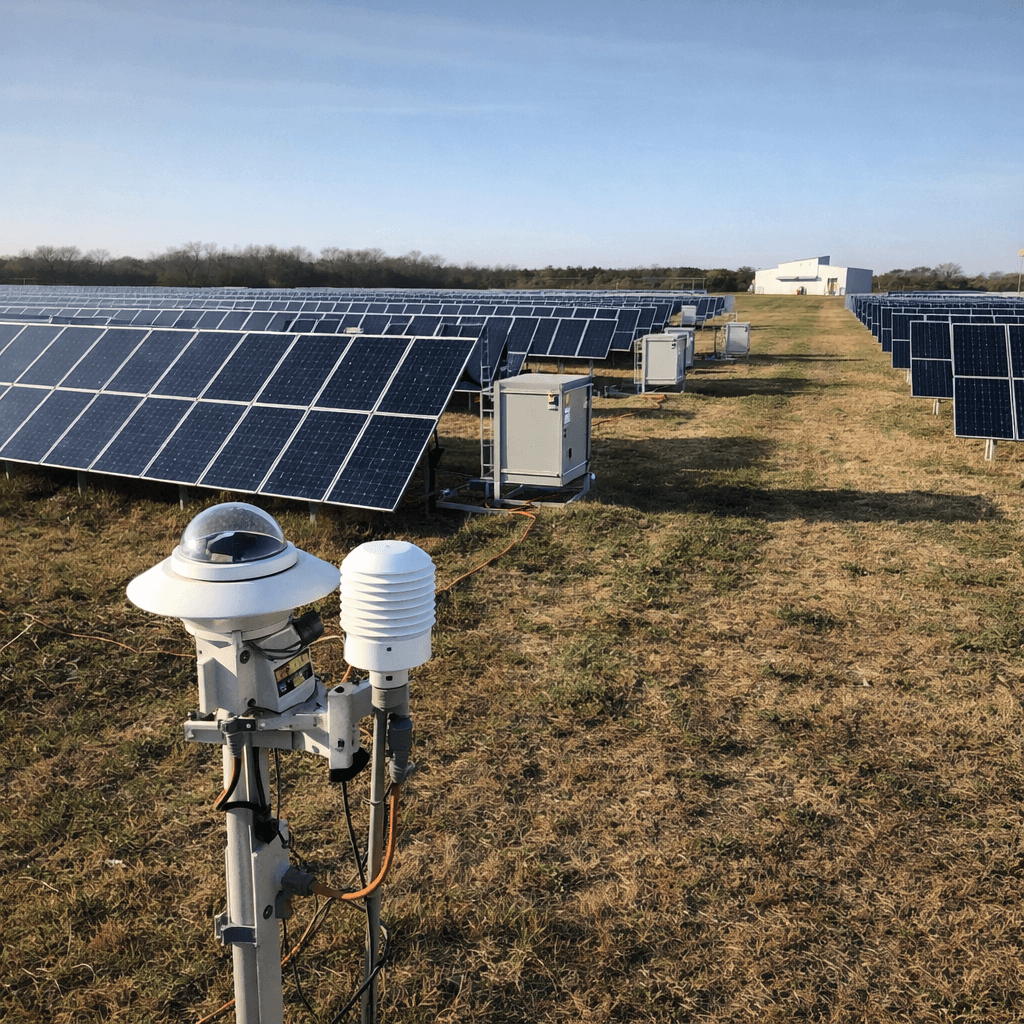
Pyranometer for Utility-Scale PV: Accuracy Classes Explained
On a utility-scale PV plant, irradiance is the reference signal behind Performance Ratio (PR), loss analysis, and many warranty and contractual conversations. When that reference is wrong, everything downstream becomes an argument: “Is the plant underperforming, or is the sensor lying?”
This article is for owners/operators, EPCs, commissioning leads, SCADA/DAS engineers, and O&M teams who want a practical explanation of pyranometer accuracy classes and how to turn a specification into trustworthy, defensible data.
Why pyranometer accuracy classes matter in utility-scale PV
A pyranometer measures solar irradiance (power per unit area), commonly reported in W/m². In PV operations, that measurement is used to normalize energy output and separate resource variability from equipment performance.
- PR and loss analysis: If irradiance is biased high or low, PR shifts with it.
- Availability and curtailment attribution: Many “expected power” baselines lean on irradiance inputs.
- Commissioning and handoff credibility: If the irradiance channel is unstable or poorly documented, COD support drags on.
Accuracy class is not just a marketing label. It’s a shorthand for multiple behaviors that affect how the sensor performs in the real world: angular response, temperature sensitivity, stability, response time, and more.
Key definitions (so the rest of this is clear)
Irradiance types you’ll see on PV sites
- GHI (Global Horizontal Irradiance): Total irradiance on a horizontal surface (direct + diffuse).
- POA (Plane of Array) irradiance: Irradiance on the same tilt/azimuth as the PV modules (or tracker plane). This is often the operational workhorse for PR and expected-power comparisons.
Thermopile pyranometer vs reference cell
- Thermopile pyranometer: A broadband radiometer designed to measure solar irradiance across a wide spectral range using a thermopile sensor under one or more domes.
- Reference cell: A calibrated PV cell that tends to respond more like the modules electrically. Many plants use both: pyranometers for standardized irradiance measurement and reference cells for PV-correlated comparisons.
How accuracy classes are defined (the practical view)
Modern pyranometer “classes” are typically based on standardized performance criteria. For pyranometers, the key international reference is ISO 9060, which defines classification and test methods for pyranometers and pyrheliometers.
Manufacturers will often present class/category alongside a set of specifications. The category is useful, but your procurement and commissioning teams still need to read the underlying metrics that drive real-world error.
Common performance characteristics that drive measurement error
- Cosine response (angle-of-incidence behavior): How accurately the sensor responds as the sun moves away from normal incidence. This is a major source of early/late-day bias.
- Spectral response: How evenly the sensor responds across different wavelengths. Atmosphere, clouds, and air mass change the spectrum throughout the day.
- Temperature dependence: Output drift as sensor body temperature changes (hot enclosure days can matter).
- Response time: How quickly the sensor reacts to changing irradiance (fast-moving clouds on large sites are a real condition, not a lab artifact).
- Zero offset: Output that appears even when irradiance is low (often driven by thermal effects and longwave exchange).
- Stability (long-term drift): How much the sensor changes over months/years between calibrations.
Operational takeaway: two sensors can have similar “accuracy class” labels but behave differently in your application if their cosine response, thermal behavior, and stability are not comparable.
ISO 9060 categories: what they generally imply for PV use
ISO 9060 defines categories (for pyranometers, commonly referenced as “Secondary Standard,” “First Class,” and “Second Class”). In general, tighter categories correspond to better performance on the error drivers above.
For utility-scale PV, the most common decision is whether to standardize on a higher-category thermopile pyranometer for PR and contractual reporting, then use additional sensors (including reference cells) for operational diagnostics and redundancy.
A practical selection guide (not a substitute for your contract requirements)
| Use case | What matters most | Typical pyranometer class approach | Notes |
|---|---|---|---|
| Lender-grade / contract-sensitive PR reporting | Low bias, strong cosine response, documented calibration, stability | Specify higher ISO 9060 category (often Secondary Standard) | Pair with tight commissioning validation and a calibration plan. |
| Operational PR trending and O&M diagnostics | Consistency and uptime; fast troubleshooting | Higher category preferred; consider redundancy | A second sensor often pays for itself the first time it prevents a misdiagnosis. |
| Fleet-wide benchmarking (many plants, many climates) | Standardized spec + consistent maintenance and calibration intervals | Pick one category and stick to it | Consistency usually beats “one-off best sensor” decisions. |
| Low-stakes trend only (non-contractual) | Basic reliability | Lower category may be acceptable | Be explicit about where it can and cannot be used (avoid PR disputes). |
What to specify beyond “accuracy class” (the checklist buyers forget)
If you only specify “pyranometer class,” you will still end up with gaps in defensibility. Add procurement language around the items below so field teams can verify compliance.
1) Calibration and traceability
- Specify that sensors ship with a calibration certificate and sensitivity (e.g., µV/(W/m²)).
- Define calibration interval expectations and who owns the process after COD.
- Document how sensitivity is applied in your datalogger/RTU scaling so it is applied once end-to-end.
2) Installation orientation and mounting requirements
- Define whether the sensor is GHI (level/horizontal) or POA (module plane).
- For POA, specify tilt/azimuth or tracker-mounted method and any required alignment tolerances.
- Include leveling requirements and verification steps in commissioning.
3) Output type and signal chain
- Confirm whether the output is low-level analog (mV), 4–20 mA, or digital (e.g., SDI-12 / RS-485, vendor-dependent).
- For analog outputs, specify cable type, grounding/shielding practice, and allowable run lengths.
- Define where scaling will happen (sensor/digitizer vs datalogger vs SCADA). Inconsistent scaling is a top cause of “bad PR.”
4) Heating/ventilation and environmental controls (if used)
Many sensors support ventilation units or heaters to reduce dew/frost and improve stability in humid or cold climates. If you specify these, also specify power source, control logic (always-on vs temperature-based), and how you will monitor their status in SCADA.
Commissioning reality: the “accuracy class” is wasted if data quality is weak
In the field, poor irradiance data is more often caused by installation and integration problems than by the pyranometer’s datasheet.
Common failure modes we see on utility-scale sites
- Wrong plane: POA sensor installed level, or a GHI sensor installed at tilt, without documentation.
- Misalignment: POA tilt/azimuth doesn’t match the array (or doesn’t match the tracker plane approach used in modeling).
- Dirty domes / maintenance gaps: Soiling biases irradiance low and inflates PR (a dangerous direction for reporting credibility).
- Double scaling: Sensitivity applied in the datalogger and again in SCADA, or W/m² inadvertently converted to kW/m².
- Time misalignment: Irradiance averaged on different intervals than power/energy, or devices not synchronized to NTP.
- Input noise: Long mV runs without proper shielding/grounding or poor terminations inside enclosures.
Field-ready validation: how to prove irradiance is trustworthy end-to-end
Use this as a commissioning procedure backbone. The goal is evidence that the signal is correct from the sensor to the historian and any KPI calculations.
- Verify physical install: confirm shading-free location, correct plane (GHI vs POA), secure mounting, and level/tilt verification.
- Verify sensor identity: record model, serial number, calibration date, sensitivity value, and any ventilation/heater accessories.
- Verify raw input: measure the sensor output at the input device (mV/mA/digital) and confirm it is plausible given conditions.
- Confirm scaling location: document exactly where sensitivity is applied and confirm it is applied once.
- Confirm SCADA point definition: units (W/m²), naming, engineering limits, and quality flags for bad/stale values.
- Check time sync: confirm NTP on datalogger/RTU and SCADA/historian so irradiance aligns with power.
- Sanity-check against expectations: compare against clear-sky expectations for the site/time, and compare to any reference cell or secondary irradiance channel if installed.
- Document the baseline: store as-built photos, tilt/level measurements, point list entries, and the calibration certificate in the turnover package.
How pyranometer class ties into IEC 61724-1 (monitoring expectations)
For PV performance monitoring, IEC 61724-1 is commonly referenced for monitoring system guidance and data quality expectations. Even when your contract doesn’t cite it explicitly, aligning documentation and monitoring discipline to IEC-style thinking (defined measurement boundaries, consistent sampling/averaging, traceable calibration) makes reporting easier to defend.
Decision criteria: choosing the “right” pyranometer for your project
Use these questions to drive a clean decision during design and procurement:
- What is the reporting boundary? POI PR reporting typically needs stricter documentation than “internal ops-only” dashboards.
- What climates will the sensor live in? Humid, dusty, or snowy sites may benefit from ventilation/heating and tighter maintenance plans.
- How will you maintain and calibrate? A high-end sensor with no cleaning/calibration plan still produces questionable data over time.
- Do you need redundancy? A second irradiance channel can prevent weeks of uncertainty when PR looks wrong.
- Is the data chain commissioning-ready? Scaling, time sync, and documentation discipline often matter more than the last decimal place on a datasheet.
Conclusion: specify the class, then prove the signal
Pyranometer accuracy classes are useful, but they only deliver value when paired with correct installation, consistent scaling, time alignment, and documentation that survives turnover. If your irradiance signal is trustworthy, PR and performance analytics become tools that speed decisions instead of creating debates.
If you’re building or upgrading a utility-scale PV monitoring stack, REIG can help you select and integrate irradiance sensors, validate scaling and time sync end-to-end, and commission your SCADA + DAS so plant data is reliable from day one.
FAQ
What is the difference between a pyranometer and a reference cell on a solar plant?
A pyranometer is a radiometer designed to measure broadband solar irradiance in W/m², typically using a thermopile sensor under a dome. A reference cell is a calibrated PV cell that responds more like the modules electrically and is often used for PV-correlated comparisons. Many utility-scale plants use both so they can cross-check irradiance signals and improve confidence in PR and expected-power analysis.
Which pyranometer accuracy class should we specify for utility-scale PV?
It depends on how the data will be used and what your contracts require, but utility-scale PR and lender/contract-facing reporting often justify specifying a higher ISO 9060 category. The class label should not be the only requirement; include calibration traceability, cosine response performance, stability, and a maintenance/calibration plan. If PR disputes are costly on your project, redundancy and commissioning validation are usually more important than marginal sensor cost differences.
Why does PR change when we replace or recalibrate a pyranometer?
PR is directly influenced by irradiance, so any change in sensor sensitivity, scaling, or installation alignment can shift the irradiance baseline and move PR. Recalibration updates the sensor’s sensitivity value, and replacing a sensor can introduce different cosine response or thermal behavior. The best practice is to document calibration changes, control scaling revisions, and run a before/after comparison to quantify the impact on KPI reporting.
What are the most common pyranometer integration mistakes in SCADA/DAS?
The most common issues are double-scaling (sensitivity applied in multiple layers), unit mismatches (W/m² vs kW/m²), and time misalignment between irradiance and power/energy. Field issues like incorrect tilt/level, shading, and dirty domes also cause large biases. A commissioning checklist that verifies raw input, scaling location, time sync, and final historian values prevents most of these problems.
How often should pyranometers be cleaned and calibrated on a utility-scale site?
Cleaning frequency depends on site conditions such as dust, pollen, snow, and rainfall patterns, but it should be frequent enough that soiling does not introduce meaningful bias into PR and expected-power calculations. Calibration intervals are typically defined by your asset management standards, sensor manufacturer guidance, and any contractual requirements. Whatever interval you choose, document it and track calibration dates and sensitivity values in the plant’s turnover and O&M records.
Further reading
References
- ISO 9060:2023 Solar energy — Specification and classification of instruments for measuring hemispherical solar and direct solar radiation
- IEC 61724-1: Photovoltaic system performance — Part 1: Monitoring (standard overview)
- NOAA GML Glossary: Solar irradiance
- Best Practices for Operation and Maintenance of Photovoltaic and Energy Storage Systems (3rd Edition) — Project overview
Next step
If you want irradiance data you can trust at COD and after turnover, REIG can help you specify the right pyranometer class, validate installation and scaling end-to-end, and commission your SCADA + DAS so PR and performance analytics reflect reality. Share your sensor list, point list, and reporting requirements with our team via /contact and we’ll help you de-risk the measurement chain.