Fiber Optic Installation Solar Farm: Direct-Buried vs Conduit
Fiber Optic Installation for Solar Farms: Direct-Buried vs Conduit (What to Choose and Why)
On a utility-scale PV project, fiber is not “just comms.” It’s the backbone that makes SCADA, DAS, PPC interfaces, revenue metering visibility, security systems, and long-term troubleshooting possible. The wrong installation method can look fine during early bring-up—then show up later as intermittent dropouts, hard-to-locate faults, and delayed commissioning evidence.
This guide is for solar owners/operators, developers, EPCs, commissioning leads, and O&M teams who need a practical way to decide between direct-buried fiber and conduit/duct fiber. We’ll cover what each method is good at, where it fails, and what to document so your communications layer supports COD readiness and long-term operations.
Quick definitions (in solar-farm terms)
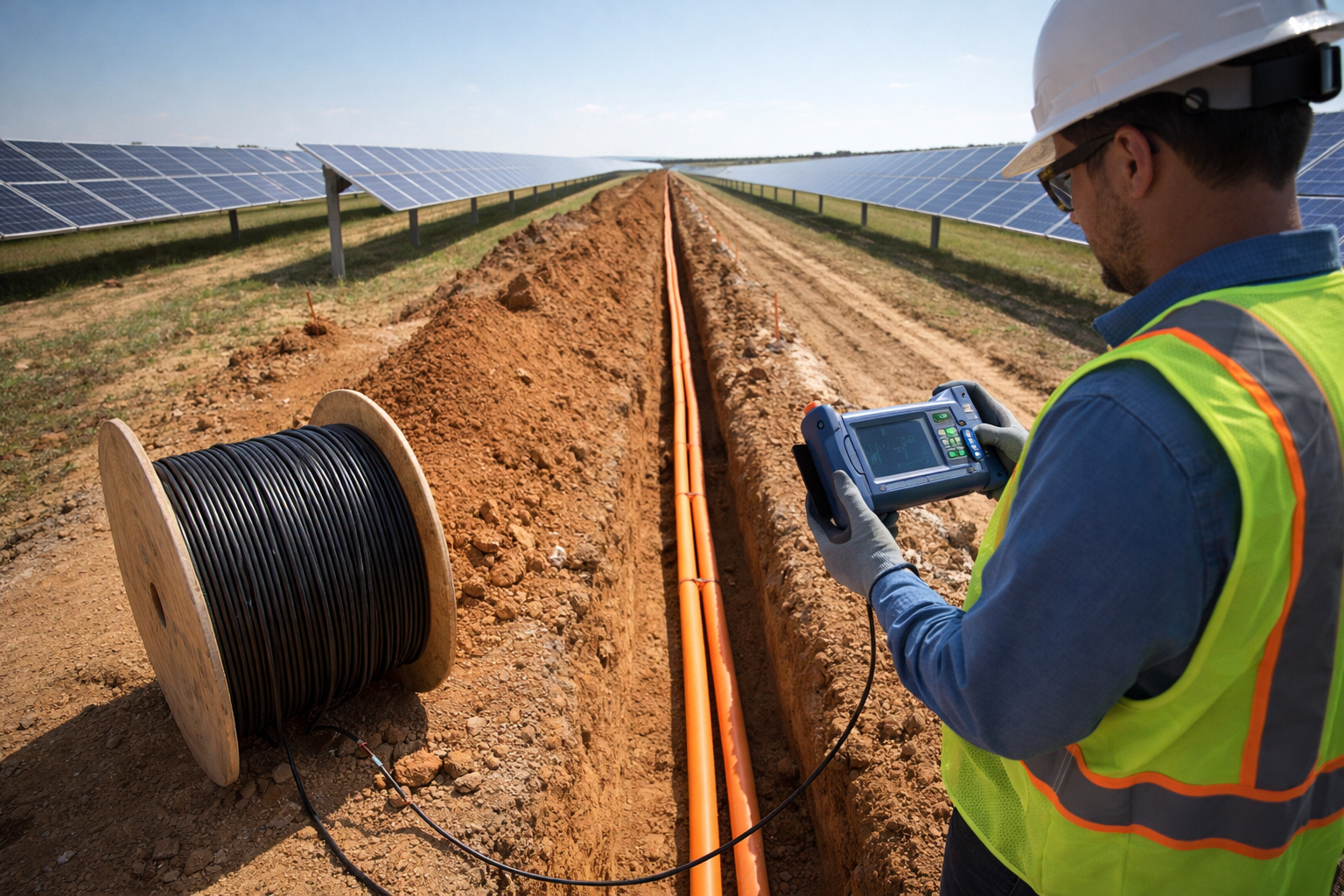
- Direct-buried fiber: an outside-plant (OSP) rated cable installed directly in a trench or by plowing/slotting, with no continuous conduit around the cable. It typically relies on the cable’s jacket/armor and water-blocking design for protection.
- Conduit (duct) fiber: fiber installed inside raceway (HDPE, PVC, or similar), often with pull boxes/handholes and sweeps for routing. The conduit provides a physical barrier and makes future replacement easier.
- OSP fiber: “outside plant” fiber and methods designed for outdoor environments and longer runs (buried, aerial, or duct). The FOA’s OSP installation guidance is a useful baseline reference for these methods. Outside Plant Fiber Optic Cable Plant Installation (FOA)
Why solar farms almost always use fiber (and why installation quality matters)
Utility-scale solar sites are geographically large and electrically noisy. Fiber is common because it supports long distances and is immune to electromagnetic interference (EMI), which is a real concern around inverters, MV equipment, and long parallel runs. Fluke’s overview of fiber in utility-scale solar highlights how common fiber-based networking is for these installations. Fiber Optics in Utility-Scale Solar Installations (Fluke)
But fiber’s electrical advantages do not make it “set and forget.” The installation method drives:
- how quickly you can deploy and commission communications during construction,
- how likely you are to get accidental damage (and how hard it is to locate),
- how quickly you can repair (or replace) a failed segment after COD, and
- how much turnover evidence you can realistically produce and maintain.
Direct-buried vs conduit: the decision framework that actually works
In the field, “which is better?” is the wrong question. A better question is: which method lowers risk for this site, this schedule, and this long-term maintenance model?
Use direct-buried when your project is schedule-driven and your corridor is stable
- Large, repetitive runs in open corridors (e.g., long home runs between blocks and a central comms building).
- Soils and routing allow continuous installation without constant obstruction work.
- Minimal future excavation risk after the site transitions from construction to operations.
In optimal conditions, OSP guidance notes that direct burial can allow installation of long lengths quickly—potentially several miles/kilometers per day depending on terrain and obstructions. FOA OSP Installation Guidance
Use conduit when your project is maintenance-driven or your corridor will change
- High-conflict areas: road crossings, pull-throughs near substations, fenced equipment yards, tracker drive lanes, or areas with repeated civil work.
- Locations with higher dig risk: where O&M expects repairs, retrofits, or expansions.
- Places where future capacity is likely needed (spares, additional strands, new cameras, met stations, BESS integration).
Direct-buried fiber for solar farms: benefits, costs, and failure modes
Why teams choose direct-buried
- Fast production: fewer materials and fewer steps than building a full duct system.
- Lower upfront material cost: you’re buying cable (often with armor) rather than cable + conduit + handholes/pull boxes.
- Simpler routing in open areas: trench/plow/slot methods can be efficient when the corridor is clear.
Where direct-buried breaks down (real solar-farm edge cases)
- Unknown excavation risk: the biggest enemy is the “one more trench” that happens after you’ve buried fiber—irrigation, grounding, retrofit conduit, or a late change order.
- Fault localization and repair time: when a buried segment is damaged, finding the exact location, excavating safely, and restoring can take longer than a conduit pull-and-replace approach.
- Rocky or obstructed soil: productivity drops quickly when you can’t maintain a consistent installation method (more handwork, more splices, more as-builts to update).
Direct-buried design choices that reduce risk
- Right cable construction: use OSP-rated cable appropriate for burial, including water-blocking; use armor where rodent/mechanical risk is high.
- Intentional slack and splice planning: plan where slack loops/splice cases will live so repairs don’t turn into “where do we have enough cable?” problems.
- Route mapping that O&M will actually use: if it’s not in a usable as-built and GIS (or equivalent), it’s effectively undocumented when a repair is urgent.
Conduit/duct fiber for solar farms: benefits, costs, and failure modes
Why teams choose conduit
- Repairability: conduit can allow you to pull new cable without re-trenching (assuming the duct remains intact and pull paths are designed well).
- Physical protection: particularly valuable at crossings and high-traffic areas.
- Future expansion: adding strands, replacing damaged cable, or upgrading counts is often simpler with spare ducts and accessible handholes.
What conduit adds (and what gets underestimated)
- More civil scope: sweeps, handholes, duct banks, and compaction standards create time and inspection overhead.
- Poorly designed pull paths become the failure mode: too many bends, tight sweeps, long pulls without intermediate access, and missing pull strings can turn a “simple pull” into a cable-damage event.
- Water management: ducts fill with water. That’s normal in many OSP systems, but it affects how you manage handholes, seals, and long-term integrity.
Side-by-side comparison table (what matters for commissioning and operations)
| Decision factor | Direct-buried fiber | Conduit/duct fiber |
|---|---|---|
| Install speed (open corridors) | Often faster when routing is unobstructed | Slower due to conduit + access structures |
| Upfront cost | Lower materials, fewer components | Higher materials and civil labor |
| Damage risk during construction | Higher if excavation continues near the route | Lower if duct is protected and mapped |
| Repair time after COD | Can be longer (locate + excavate + restore) | Often faster (isolate + pull/replace), if pull paths are good |
| Future expansion | Harder; may require new trenching | Easier with spare ducts and accessible handholes |
| Documentation burden | High (exact route matters for dig safety) | High (duct mapping + handhole indexing), but usually more maintainable |
A practical hybrid approach (common on utility-scale PV)
Many well-run solar sites use both methods deliberately:
- Direct-buried for long, stable corridors where the site is unlikely to be reworked after construction.
- Conduit for crossings, substation/POI areas, fenced yards, and anywhere you expect repeated access or change.
The key is to treat this as an engineering decision with deliverables (route drawings, splice plans, and test evidence)—not as an installer preference.
Termination and connectivity: don’t let the last 10 feet destroy the whole link
Solar farms frequently involve many endpoints: inverters, tracker controllers, weather stations, meters, security systems, and network switches. Your termination strategy affects schedule, quality, and long-term serviceability.
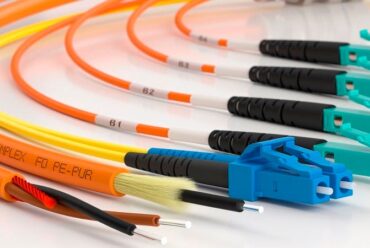
- Pre-terminated assemblies can speed installation, but require careful slack management and protection of connector ends during pulling.
- Field-installable connectors (including fusion splice-on connector approaches) can reduce slack issues and allow on-site termination; OFS discusses these options for wind and solar environments. Fiber Optic Cables and Connectivity for Wind & Solar Farms (OFS)
Whatever you choose, standardize it. Mixed connector types and inconsistent patching are a common source of “it worked yesterday” troubleshooting.
Commissioning-ready fiber: acceptance tests and evidence you should require
If your ICP is “COD readiness with defensible data,” fiber should be tested and documented like a critical system. The goal is not just that links come up—it’s that they stay up and you can prove why.
1) As-built route and strand mapping (before you demobilize)
- Route drawings updated to reflect actual paths and crossings.
- Handhole/pull box index and labeling scheme (if conduit).
- Splice enclosure locations and fiber counts.
- Strand mapping: “this switch port uses these strands end-to-end.”
2) Test plan (OTDR + end-to-end)
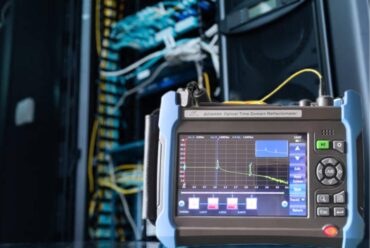
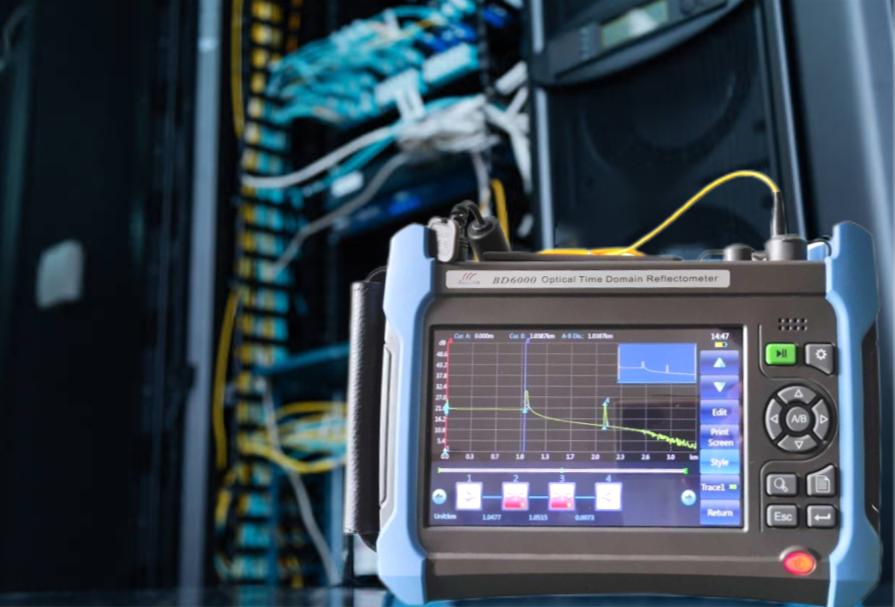
- OTDR traces per strand (or per required subset) to locate events and document baseline health.
- Insertion loss (OLTS) test end-to-end to confirm link loss is within the optic budget for the transceivers.
- Link stability evidence under realistic polling and traffic loads (SCADA/DAS plus any cameras/remote access paths).
Use the same evidence mindset you should use for SCADA/DAS: results captured, dated, and traceable to the specific fiber segments and endpoints.
3) Operational readiness checks (what O&M will rely on)
- Clear labeling at panels and enclosures (consistent naming).
- Spare strands and documented spare allocation.
- Patch cord standardization (types, lengths, storage).
- Defined troubleshooting workflow: where to check first (switch alarms, optics levels, ring status, link counters).
Common mistakes that create “mystery comms” problems after COD
- Choosing direct-buried without controlling future digging: no enforced dig restrictions, poor as-builts, or no locating plan.
- Conduit with bad pull geometry: too many bends or missing intermediate access creates cable damage and difficult repairs.
- Inconsistent termination and patching: mixed connector standards and undocumented changes during punch-list work.
- Testing that stops at “link is up”: no OTDR/OLTS baselines, no strand mapping, and no turnover package that survives personnel changes.
Where REIG fits: fiber that supports commissioning-ready SCADA + DAS
Renewable Energy Integration Group (REIG) approaches fiber as part of the same commissioning-ready system as SCADA and DAS. That means the physical layer choice (direct-buried vs conduit) is evaluated against operational needs: validated signals end-to-end, stable communications paths, and clean documentation that supports troubleshooting and uptime after COD.
If your team has ever lost days to “is it the network or the equipment?” you already know why this matters: communications quality becomes data quality—and data quality becomes COD and performance risk.
Conclusion: pick the method that minimizes long-term risk for your site
Direct-buried fiber can be a smart choice for fast, large-scale deployment in stable corridors. Conduit-based fiber can be the right answer where future change, crossings, and repairability drive risk. Many utility-scale solar farms benefit from a hybrid approach that uses each method where it is strongest.
The practical goal is simple: a communications backbone you can commission quickly, prove with evidence, and support confidently for years.
If you’re scoping fiber as part of a SCADA + DAS build (or fixing recurring comms-driven data gaps), REIG can help you select an installation approach, validate the fiber end-to-end, and deliver a commissioning-ready turnover package that supports COD and long-term operations.
FAQ
Is direct-buried fiber acceptable for utility-scale solar farms?
Yes—direct-buried OSP-rated fiber is widely used when the route is stable and excavation risk is controlled. The key is matching the cable construction to site conditions (mechanical risk, rodents, water exposure) and producing accurate as-builts and test evidence. If the corridor is likely to change after installation, conduit is often the lower-risk choice.
When should we require conduit for solar farm fiber?
Conduit is typically justified at crossings (roads/ditches), in high-traffic areas, near substations and fenced yards, and anywhere you expect future modifications. It can also be a good choice when O&M needs faster repairability after COD. The conduit system must be designed for pullability (sweeps, access spacing), or it can create its own failure modes.
What fiber tests should be included in turnover for a solar project?
At minimum, include OTDR traces to document event locations and a baseline, plus end-to-end insertion loss testing to confirm the optic budget is met. Also include strand mapping, endpoint labeling standards, and a record of any splices/closures. These artifacts make post-COD troubleshooting faster and reduce “guesswork” repairs.
Does conduit eliminate water and reliability issues?
No. Many conduit systems will accumulate water, and that can be normal in OSP environments if managed correctly. Reliability comes from good duct design, sealed handholes where appropriate, correct cable selection, and complete documentation—not from conduit alone.
How does the fiber installation method affect SCADA/DAS commissioning?
It affects how quickly you can stabilize communications, how repeatable your link behavior is under load, and how easily you can prove the physical layer with test evidence. Poor fiber documentation or incomplete testing often shows up as intermittent device offline events and historian data gaps later. A commissioning-ready approach treats fiber validation as part of end-to-end signal verification, not a separate handoff.
Further reading
References
- Outside Plant Fiber Optic Cable Plant Installation (Fiber Optic Association)
- Fiber Optics in Utility-Scale Solar Installations (Fluke)
- Fiber Optic Cables and Connectivity for Wind & Solar Farms (OFS)
- Case Study: Solar Farm Network Requirements (Planet Technology)
- Fiber Optics in Solar Energy Applications (Broadcom Avago)
Next step
If you’re deciding between direct-buried and conduit fiber for a utility-scale PV site—or you’re dealing with comms-driven “mystery” data gaps—REIG can help you scope the communications layer as part of a commissioning-ready SCADA + DAS stack, including fiber verification, strand mapping, and clean turnover documentation.