
Single-Mode vs. Multi-Mode Fiber: Choosing the Right Fit for Your Project
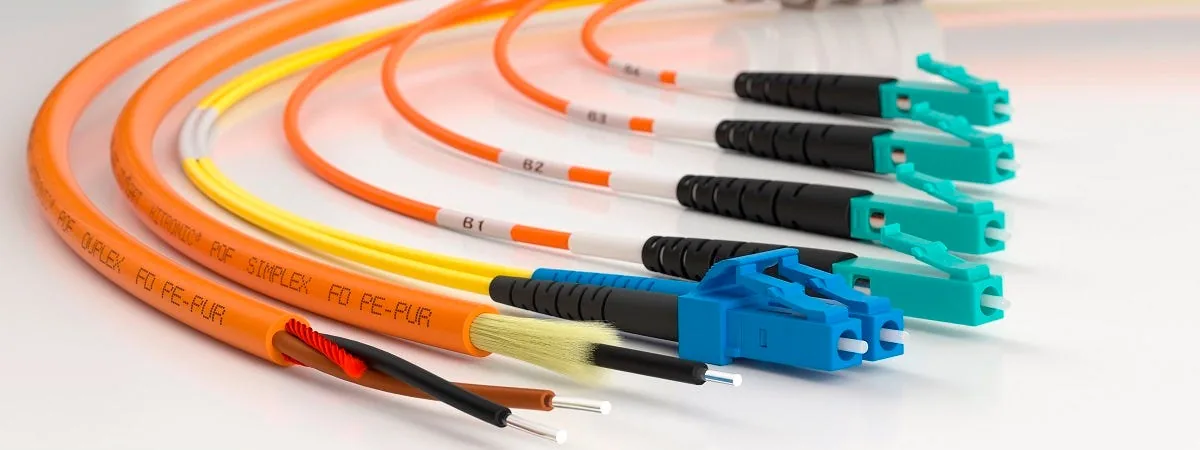
Choosing between single-mode vs. multi-mode fiber is one of the first decisions that shapes how a solar farm, wind project, or data center network performs for the next twenty years. The two categories split further into standards such as OS2, OM1, and OM3, each with different core sizes, bandwidth ceilings, and maximum run lengths. Get the choice wrong on a long SCADA backbone and you will be replacing cable runs before the warranty on the panels even lapses.
Single-Mode vs. Multi-Mode Fiber: What Sets Them Apart
The single-mode vs. multi-mode fiber decision comes down to core size and the number of light paths each fiber allows. Single-mode OS2 fiber uses a 9-micron core that carries one light path, cutting modal dispersion to near zero and enabling 40 km plus runs. Multi-mode OM1 and OM3 fiber use 50 to 62.5-micron cores that carry many light paths over much shorter distances.
OS2 Single-Mode Fiber: Specifications and Use Cases
OS2 fiber is the industry standard for outdoor single-mode applications, built around the core size and attenuation limits set out in TIA structured cabling standards and the IEC 60793 fiber specification. Its 9-micron core allows only one mode of light to travel, which virtually eliminates modal dispersion and lets a signal travel 40 km or more with minimal loss. On renewable sites, a single OS2 run can span an entire solar array without a repeater.
- Use case: utility-scale renewable projects, substation SCADA backbones, and telecom long-haul links.
- Advantages: future-ready bandwidth, very low attenuation, and reliable performance in high-voltage renewable environments.
- Trade-off: the cable itself is inexpensive, but OS2 transceivers and switching hardware cost more than their multi-mode counterparts, which is the real line item to budget for.
OM1 and OM3 Multi-Mode Fiber: Specifications and Use Cases
Multi-mode fiber trades distance for lower-cost short-haul bandwidth, and the two standards most installers will see on a site are OM1 and OM3. OM1 is the legacy 62.5-micron standard built for LED light sources, while OM3 is the modern 50-micron standard built for laser-based VCSEL sources, with four times the bandwidth of OM1 at 850 nm.
OM1 Fiber (Legacy Standard)
- Core size: 62.5 microns.
- Performance: limited bandwidth of 200 MHz per km at 850 nm.
- Distance: short runs only, typically up to 300 meters with older LED light sources.
- Status: considered outdated for new installations but still found in legacy building networks.
OM3 Fiber (Modern Standard)
- Core size: 50 microns.
- Performance: built for laser-based VCSEL light sources, with bandwidth of 2000 MHz per km at 850 nm.
- Distance: supports 10 Gb up to 300 m, and 40 Gb or 100 Gb up to 100 m.
- Status: common in data centers, control buildings, and industrial short-haul connections.
Compared to OM1, OM3 provides far greater bandwidth, and IEEE 802.3 Ethernet standards such as 10GBASE-SR and 40GBASE-SR4 call for OM3 or better at nearly every rate above 1 Gb, which is why Corning and most other major fiber manufacturers now ship OM3 or OM4 as the default multi-mode product for new builds.
OS2 vs. OM1 vs. OM3: Comparison Table
OS2, OM1, and OM3 differ most in core size, bandwidth, and maximum distance. The table below lines up those specifications so an engineer can match the standard to the run length and data rate a project needs.
| Specification | OS2 (Single-Mode) | OM1 (Multi-Mode) | OM3 (Multi-Mode) |
|---|---|---|---|
| Core size | 9 microns | 62.5 microns | 50 microns |
| Light source | Laser | LED | VCSEL (laser-based) |
| Bandwidth at 850/1310 nm | Effectively unlimited | 200 MHz per km | 2000 MHz per km |
| Max distance | 40 km or more | Up to 300 m | 300 m at 10 Gb, 100 m at 40/100 Gb |
| Typical use | Outdoor backbones, SCADA, telecom long-haul | Legacy indoor runs | Data centers, control buildings |
| Relative cable cost | Low | Low | Moderate |
| Relative hardware cost | Higher | Lower | Moderate |
How to Decide Between OS2, OM1, and OM3
The decision comes down to two questions: how far must the signal travel, and how much bandwidth must the link carry. Distance rules out multi-mode fiber beyond a few hundred meters, and bandwidth rules out OM1 for new builds.
Distance requirements
- OS2 (single-mode) is the only practical choice for long-haul or campus-scale runs, such as a fiber ring connecting inverters across a site.
- OM1 and OM3 (multi-mode) are best suited to short indoor runs, control rooms, or rack-to-rack connections.
Bandwidth needs
- OS2 single-mode is the standard for outdoor networks and long-haul reliability.
- OM3 multi-mode is the cost-effective choice for short, high-speed indoor links.
- OM1 fits only existing systems that need compatibility with older hardware.
Budget and hardware costs
Cable cost rarely decides a single-mode vs. multi-mode fiber project. The bigger line item is the transceivers, switches, and patch hardware on each end, and OS2 hardware usually costs more than OM3 hardware for the same port count. Projects that mix an outdoor OS2 backbone with indoor OM3 drops often get the best balance of reach and cost.
Single-Mode vs. Multi-Mode Fiber: Cost and Long-Term Considerations
Single-mode vs. multi-mode fiber cost comparisons that only look at cable price miss the real number: total installed cost per working link over a 20-year service life, a point covered in our breakdown of fiber-optic cable types for renewable energy sites. OS2 cable can cost less per meter than OM3, but OS2 transceivers often cost several times more than multi-mode optics, so a short indoor link almost always favors OM3 on total cost.
Over a 20-year horizon, though, the calculus flips for anything leaving the building. Trenching, conduit, and labor cost far more than the fiber or the optics, so a site that saves a few thousand dollars under-building its OS2 backbone can spend ten times that re-trenching a right-of-way five years later. The Fiber Optic Association publishes design guidance that treats this life-cycle cost, not the cable's sticker price, as the real comparison point.
Real-World Example: Fiber Backbone at a 280 MW Solar Site
On a 280 MW solar project our team supported in West Texas, the site ran OS2 single-mode fiber in a 24-strand backbone ring connecting six substations and the main control building across roughly 11 miles of right-of-way, then dropped to OM3 multi-mode patch cable inside each control building for the final 50 to 80 meters to switches and RTUs.
That split, covered in our case study on utility-scale solar SCADA design, let the project run one long-haul OS2 ring for relay protection traffic while keeping cheaper OM3 optics for short indoor runs where distance was never a factor. The design left six dark strands in the OS2 ring for future growth, a decision that paid off eighteen months later when the site added a battery storage block and needed new SCADA points without a new trench.
A Trade-Off We Underestimated on an Earlier Project
Not every project has gone this smoothly. On an earlier 80 MW wind project, our team specified a 12-strand OS2 backbone because that covered the SCADA and relay traffic the client asked for at the time. Two years later, the client added a fiber-based security camera network and a separate metering link, and the 12-strand count was gone. We had to splice in a parallel run along an access road that had since been fenced and re-graded, which cost about four times what pulling 24 strands during the original trench work would have cost.
The lesson: on any site where OS2 goes into the ground once, strand count should be sized for the project the client will have in five years, not the one being built today. We now default to at least double the day-one strand count on any outdoor OS2 run, and have not had to re-trench a backbone since.
Matching single-mode vs. multi-mode fiber to a project's actual distance, bandwidth, and growth plan is what keeps a network reliable for the next license renewal instead of the next budget cycle. OS2 covers the outdoor backbone, OM3 covers the short indoor link, and OM1 only belongs on a job where it is already in the ground.
Frequently Asked Questions About Single-Mode vs. Multi-Mode Fiber
Is OS2 single-mode fiber always better than OM3 multi-mode fiber?
No. OS2 single-mode fiber wins on distance and future bandwidth, since its 9-micron core supports 40 km or more with almost no modal dispersion, but that advantage costs more in transceivers and switching hardware. OM3 multi-mode fiber is the better choice for short runs under 300 meters, such as rack-to-rack links inside a control building or data center, because its optics are far less expensive for the same port count. Most utility-scale renewable sites use both: OS2 for the outdoor backbone between substations, and OM3 for the short indoor drops to switches and RTUs.
What's the real-world difference between single-mode vs. multi-mode fiber for a solar or wind SCADA network?
On a solar or wind SCADA network, the real-world difference between single-mode vs. multi-mode fiber is distance and growth room. A solar or wind site typically spans hundreds of acres to several square miles, which puts every inter-substation link well beyond the 300-meter limit of OM1 or OM3 multi-mode fiber. OS2 single-mode fiber, with its 40 km plus range, is the only standard that reaches across that distance without repeaters or media converters, which is why it is the default choice for the outdoor backbone on nearly every utility-scale renewable project we design.
Can OM1 fiber be mixed with OM3 or OS2 on the same project?
OM1 and OM3 multi-mode fiber should never be spliced or connectorized together as one continuous run, because their different core sizes and bandwidth ratings cause coupling losses and unpredictable performance. They can coexist on the same site as separate, clearly labeled runs, such as an older OM1 segment left in a legacy building next to a new OM3 run in a newer control house. OS2 single-mode fiber is a different category entirely and connects to multi-mode fiber only through a media converter, never a direct splice, since single-mode and multi-mode light sources and connectors are not interchangeable.
Does choosing single-mode vs. multi-mode fiber change long-term maintenance costs?
Yes. Choosing single-mode vs. multi-mode fiber affects maintenance costs mainly through repair access and spare parts, not the fiber itself. OS2 single-mode runs that go underground or overhead between substations are expensive to access when damaged, so most projects pull extra dark strands up front rather than plan on frequent repairs. OM3 multi-mode runs inside a control building are cheap and fast to re-terminate or replace, since the cable and optics cost far less and the run is short enough to re-pull in an afternoon. Over a 20-year project life, that access difference matters more than the original cable price.