
Its More Than a Big Grey Box – Hardware Basics
Last time we covered the full range of data a solar site generates, from the must-have readings to the small points that seem to carry no weight on their own. All of it matters once a solar communications enclosure starts collecting it, because the value shows up in how the data gets used, not just in how much gets stored. This article turns to the hardware side: the enclosures, sensors, and field devices that make a DAS or SCADA system work.
What Is a Solar Communications Enclosure?
A solar communications enclosure is the weatherproof cabinet that houses the data logger, networking gear, and backup power for a site's DAS or SCADA system. Most utility-scale sites use one main enclosure plus several smaller network enclosures spread across the array, tied together by copper, fiber, or cellular links.
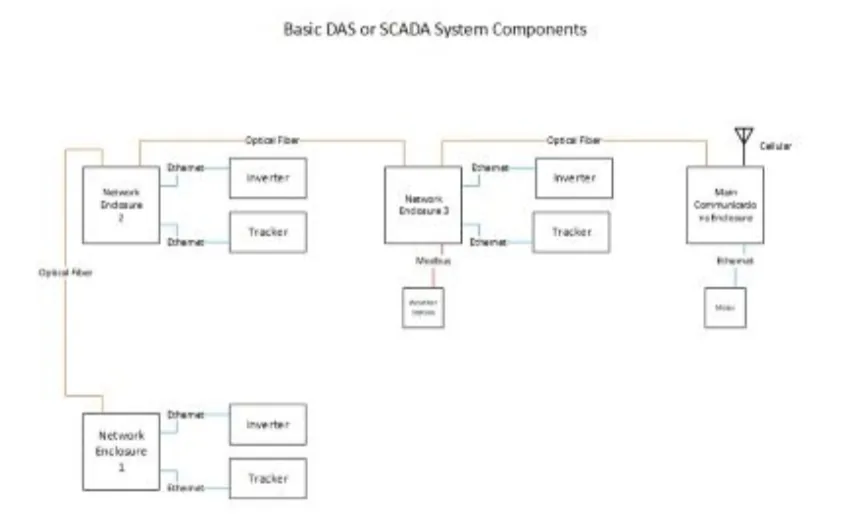
Most of these cabinets are steel or fiberglass, rated NEMA 3R or NEMA 4X depending on how exposed the mounting location is, and sized to leave room for a technician to work inside without removing field wiring. The drawing below shows a typical layout: a main enclosure near the point of interconnection, field network enclosures positioned closer to groups of inverters or trackers, a weather station on its own pole, and, on larger sites, a dedicated fiber splicing enclosure. Each piece has a specific job, and together they form the physical backbone that carries data from the array to the people who need to see it.
Inside the Main Communications Enclosure
The main enclosure is the control point for the entire site: it holds the data logger, power supply, optional UPS, Ethernet switch, cellular modem, terminals, and circuit protection that keep the DAS or SCADA system running. Everything else on the site, from inverters to weather sensors, reports back through this one cabinet.
Here is a closer look at what each listed item in the drawing does on site:
- Main communications enclosure – Houses the data logger, which is the brain behind the DAS or SCADA system, plus a power supply, optional UPS, Ethernet switch, cellular modem, terminals, a circuit breaker, and fuses.
- Network enclosures – Field-installed cabinets that house an Ethernet switch, power supply, optional UPS, a Modbus/TCP adapter when needed, a terminal, a circuit breaker, and fuses.
- Weather station – A set of outdoor-mounted sensors that measure irradiance, ambient temperature, back-of-module temperature, wind speed and direction, and other meteorological readings.
- Fiber splicing enclosure – Not shown in the drawing above, this dedicated enclosure provides a splice tray and related hardware to fusion-splice optical fiber independently of the main enclosure.
We plan on publishing a separate article devoted to fiber routing, splicing, and connections, since that topic deserves more room than a hardware overview can give it.
Network Enclosures for Field-Installed Equipment
Network enclosures sit closer to the equipment they serve, usually one per group of inverters or trackers, so a single Ethernet or Modbus/TCP run does not have to stretch across the whole site. Each one repeats the same core pattern as the main enclosure, scaled down: switch, power, protection, and a terminal for field wiring, often in a smaller NEMA 4X box mounted directly on a rack or pad.
On a site with dozens of inverters, string combiners, or tracker controllers, these smaller enclosures are what keep cable runs short and signal quality high. A data logger a quarter mile from an inverter is a lot more reliable when a network enclosure sits between them than when a single cable tries to make the whole run. Spacing them every few hundred feet also makes troubleshooting faster, since a technician can isolate a fault to one segment instead of walking the entire run.
On a 120 MWac site REIG Solar commissioned in Pecos County, Texas, the design called for twenty-two network enclosures feeding a single main enclosure, each one serving four to six string inverters over a dedicated Modbus/TCP run. Field data from that project showed combiner-to-logger packet loss stayed under one percent once the team shortened the longest cable run from roughly 1,800 feet to under 600 feet by adding two extra network enclosures mid-row. That kind of adjustment is cheap during design and expensive after the array is energized, which is why REIG Solar lays out network enclosure spacing before the first conduit goes into the ground.
Weather Stations and Fiber Splicing Enclosures
A weather station enclosure and its outdoor sensors report irradiance, ambient and back-of-module temperature, and wind speed and direction, data that lets an operator tell the difference between an inverter underperforming because of a fault and one underperforming because of the weather. A fiber splicing enclosure, where the site has one, keeps fusion splicing work out of the main enclosure entirely.
Specialty equipment on a solar site is usually supplied and installed by other trades rather than by the DAS or SCADA integrator. This is not meant to be an exhaustive list, but it is a useful starting point for understanding how a control cabinet talks to the many device types on a site:
- Inverters, central or string, that convert the array's DC output to AC
- Single axis trackers that rotate modules to follow the sun through the day
- Metering equipment used for utility or revenue-grade measurement
- Protection relays that trip breakers during a fault condition
- Transformers that step voltage up for transmission
- Plus other balance-of-system equipment, depending on the site
We will cover the particulars of these enclosures and the systems behind them in future articles, including how a DAS/SCADA integration ties specialty equipment back into a single control point.
Why UL Listing Matters for Your Communications Enclosure
A communications enclosure should carry a listing from a recognized testing agency, such as UL, CSA Group, or Intertek's ETL, before it goes into the field. That listing tells the installer, owner, and inspector that the enclosure has already passed independent safety and reliability testing, which matters more once it is carrying live power and feeding data into a system built around standards such as the SunSpec Modbus device models many data loggers rely on.
| Listing Mark | Testing Organization | Major U.S. Test Lab | Standard Typically Applied | NRTL Status |
|---|---|---|---|---|
| UL | Underwriters Laboratories | Northbrook, Illinois | UL 508A | OSHA-recognized NRTL |
| CSA | CSA Group | Cleveland, Ohio | CSA C22.2 No. 14 | OSHA-recognized NRTL |
| ETL | Intertek | Arlington Heights, Illinois | UL 508A | OSHA-recognized NRTL |
At REIG Solar, we have earned the right to place the UL sticker on our listed enclosures, built and tested to UL 508A, the standard for industrial control panels, which tells the installer, owner, and inspector that this hardware has met the standards required for safety, operation, and reliability. Yes, it costs more than some other agencies would charge, but we build some of the best systems we can, and the UL approval backs that up. If your team is still speccing UL-listed hardware for an upcoming site, our earlier article on what data is worth collecting is a good next read, and our fiber splicing guide covers the enclosure this article only touches on.
Frequently Asked Questions
What is the difference between a DAS and a SCADA system?
A DAS, or data acquisition system, focuses on collecting and recording performance data, such as irradiance, temperature, and inverter output, without directly controlling site equipment. A SCADA system, or supervisory control and data acquisition system, builds on that same data layer but adds remote control, letting an operator open a breaker, adjust a tracker, or respond to an alarm in real time. Both systems rely on the same main enclosure, the same field network enclosures, and the same weather station sensors, so the hardware differences are smaller than the differences in how the two systems get used day to day.
What components go inside the main enclosure?
The main communications enclosure on a solar site typically houses the data logger, which is the central computer that gathers field data, along with a dedicated power supply, an optional uninterruptible power supply for backup during outages, an Ethernet switch, a cellular modem for remote connectivity, terminal blocks for field wiring, and circuit breakers and fuses for protection. Together these parts turn a bare metal box into the control point for the entire DAS or SCADA system, which is why installers treat this enclosure as the most important piece of hardware on the pad.
Why does a communications enclosure need a UL listing?
A UL listing means an independent testing agency has evaluated the communications enclosure against a published safety standard, often UL 508A for industrial control panels, and confirmed it performs as intended under heat, moisture, and electrical fault conditions. For an installer, owner, or inspector, that sticker is a fast way to confirm the enclosure meets code without re-testing it on site. CSA and ETL offer comparable third-party listings, and REIG Solar chooses UL for most of its enclosures because the standard is recognized by authorities having jurisdiction across the United States, which keeps inspections moving and reduces the chance of a rejected installation.
Do solar sites need a dedicated fiber splicing enclosure?
Most utility-scale solar sites benefit from a dedicated fiber splicing enclosure, separate from the main enclosure, because fusion splicing fiber optic cable is a precise job that takes time and should not require opening the primary enclosure that houses the data logger and network gear. A standalone splice enclosure gives technicians a splice tray and workspace to join or repair optical fiber runs between the main enclosure and the field network enclosures without disturbing live equipment. REIG Solar typically specifies this as a separate line item on the bill of materials, even though the detail is easy to miss during early design.