
Good Work
In Raleigh, NC, Baker Roofing Company fits an entire company philosophy into 21 words: "We Shall Always Do Good Work. Profit and Loss." This is the last of seven REIG posts on Business 101, and I am closing the series by borrowing that line, because good work is also the test REIG applies to its own solar monitoring software, SCADA support, and every site we watch day and night.
What Baker Roofing's Slogan Teaches About Solar Monitoring Software
In Raleigh, NC, Baker Roofing Company has a slogan. It's on their website, truck bumpers, and marketing materials, everywhere there is a point of contact with a customer. It's short, to the point, and memorable, all good qualities for a company's message. Here is what the slogan says:
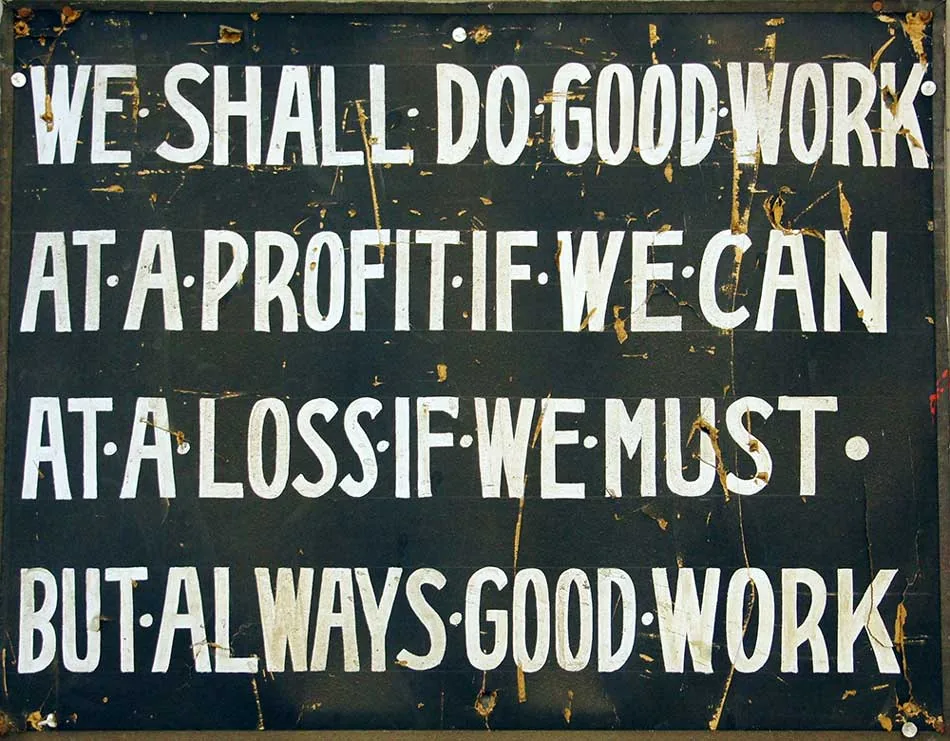
The more I think about this collection of 21 simple words, the more I notice the weight behind it. WE SHALL is an imperative statement with no ambiguity. GOOD WORK rules out mediocrity. PROFIT AND LOSS ties the financial result directly to performance. ALWAYS is a statement of continuity and commitment to doing it right, every time.
So to the Baker Roofing team, congratulations on telling the world who you are and how you will perform in so few words. Those 21 words say more than a long explanation of what a company believes and values ever could. Say what you mean and mean what you say. Baker's slogan is a clean example of doing exactly that, and it is the same standard REIG holds its own solar monitoring software and SCADA support to on every project we run.
Why Good Work Is REIG's Standard for Every Solar Project
This is the seventh and final REIG post in the Business 101 series, and with full credit to the Baker team, I am borrowing their line to close it out. Across the series we covered the five things that define a business and its culture: integrity, innovation, service, quality, and communications. Good work shows up when all five are held together in equal measure, not when one gets to carry the rest.
When something other than profit sits at the core of who you are, good work tends to follow on its own. A monitoring provider can write pleasant mission language and still ship software that drops data for hours without anyone noticing. Good work is the opposite habit: a technician who answers, a data feed that stays current, and a company that treats a missed target as a problem to fix today, not a footnote for next quarter's review.
Supervisory control and data acquisition, or SCADA, is the layer that makes that habit visible. SCADA is the combination of hardware and software a solar site uses to collect data from inverters, meters, and weather stations, then surface that data to an operator in near real time so a fault gets caught in minutes instead of showing up as a bad number on next month's invoice. Good solar monitoring software does not just display that data, it also flags the moment a reading drifts outside normal range, logs the event with a timestamp, and routes an alert to a person who can act on it. That is the difference between a dashboard that looks good in a demo and a system an asset owner can actually rely on at 2 a.m. when an inverter string goes quiet.
What Separates Reliable Solar Monitoring Software From the Rest
Reliable solar monitoring software combines three things most spec sheets skip: a short data refresh interval, automated alarm escalation, and historical retention long enough to support a performance ratio dispute years after commissioning. REIG holds more than 40 commercial and utility-scale sites we monitor across the Southeast to that same three-part standard.
| Capability | Baseline Monitoring Tools | REIG Monitoring Standard |
|---|---|---|
| Data refresh interval | 15 minutes or slower | 1 minute or faster on SCADA-linked sites |
| Alarm escalation | Email only, no routing | Automated routing to an on-call technician |
| Historical data retention | 90 days to 1 year | Full project life, archived for PPA disputes |
| Integration with SCADA/PLC | Limited or none | Native Modbus and OPC UA support |
| Named point of contact | Rarely | Yes, every account |
| Response-time commitment in writing | No | Yes, four hours standard, one hour for site-down alerts |
The National Renewable Energy Laboratory publishes performance monitoring guidance for PV fleets that serious operators measure their own systems against, and the Solar Energy Industries Association tracks the workforce and reliability pressure that makes consistent service hard to hold at scale across the industry. REIG's own SCADA engineers train against the credentialing standard the North American Board of Certified Energy Practitioners sets for PV installation and commissioning, and we size every SCADA monitoring deployment and data acquisition build to that same bar before a site goes live.
How the Business 101 Series Builds a Culture of Good Work
Like Baker, REIG commits to doing good work. It is in our DNA. It is who we are, what we do, how we deliver, and why we exist, whether the job is replacing a failed combiner box or writing the next post in this series.
Thanks for taking the time to read this series.
Keith
###
Keith Davis is the president of Renewable Energy Integration Group (REIG), a Charlotte, NC based firm focused on all things control, data acquisition and SCADA in the commercial, industrial, and utility solar PV marketplace. He and his team are innovators and leaders in the industry and provide professional hardware, dependable monitoring software and service beyond the expected. We take the complexity out of solar data!
REIG's field technicians hold current NABCEP PV installation and commissioning credentials, and the team on our team page trains every year on the SCADA communication protocols most utility-scale sites already run, backed by the same U.S. Department of Energy Solar Energy Technologies Office reliability benchmarks referenced earlier in the Business 101 series.
Frequently Asked Questions About Good Work and Solar Monitoring Software
What does "good work" mean in practice?
Good work means REIG judges its solar monitoring software and SCADA support by the same profit-and-loss standard Baker Roofing applies to its own slogan: results, not promises. In practice that means a technician answers within a written response window, a data feed that drops gets flagged and fixed before a customer has to ask, and a missed target triggers an internal review rather than a shrug. The standard shows up in day-to-day details like alarm response time and historical data retention, not just in a mission statement on a homepage. A system can look polished in a sales demo and still fail this test if nobody is accountable when it drifts.
How does REIG's Business 101 series connect to its monitoring standards?
REIG's Business 101 series covers five pillars: integrity, innovation, service, quality, and communications, and each one maps to a specific operational commitment rather than a poster on a wall. Integrity means we tell an asset owner the truth about a fault even when the cause traces back to our own equipment. Innovation means we adopt a new SCADA protocol or sensor when it actually improves data accuracy, not because it is new. Service, covered earlier in this series, means a technician answers and follows through on a response-time commitment. Quality and communications round out the list, and good work is simply what happens when a team holds all five at once instead of trading one off against another.
What should a solar asset owner look for in monitoring software?
An asset owner evaluating monitoring software should ask for real uptime numbers from the last four quarters, not the figure printed in the contract, and ask exactly how an outage gets reported: automated email, a phone call, or nothing until the monthly invoice looks wrong. Strong solar monitoring software pairs a short data refresh interval with automated alarm routing to a named technician, plus retention deep enough to support a performance ratio dispute years later. Ask for a case study showing how a specific incident was caught and fixed, not just a brochure claiming high uptime. The U.S. Department of Energy's Solar Energy Technologies Office tracks O&M cost and reliability benchmarks that are useful for sanity-checking what a vendor promises against what the broader industry actually delivers.
How often should this kind of monitoring be audited for data accuracy?
REIG recommends a full data-accuracy audit on solar monitoring software at least once a year, with a lighter spot check every quarter on any site carrying a PPA with a tight measurement-uncertainty requirement. The audit should compare SCADA-reported production against a calibrated reference meter, check that alarm thresholds still match current equipment specifications after any hardware swap, and confirm historical data has not been silently truncated by a storage limit. Sites that skip this step often discover a sensor drift or a dropped data feed only when a monthly production report looks wrong, by which point months of billing-grade data may already be compromised. An annual audit, documented and dated, is cheap insurance against that outcome.