
BESS fire safety NFPA 855 solar: utility-scale compliance guide
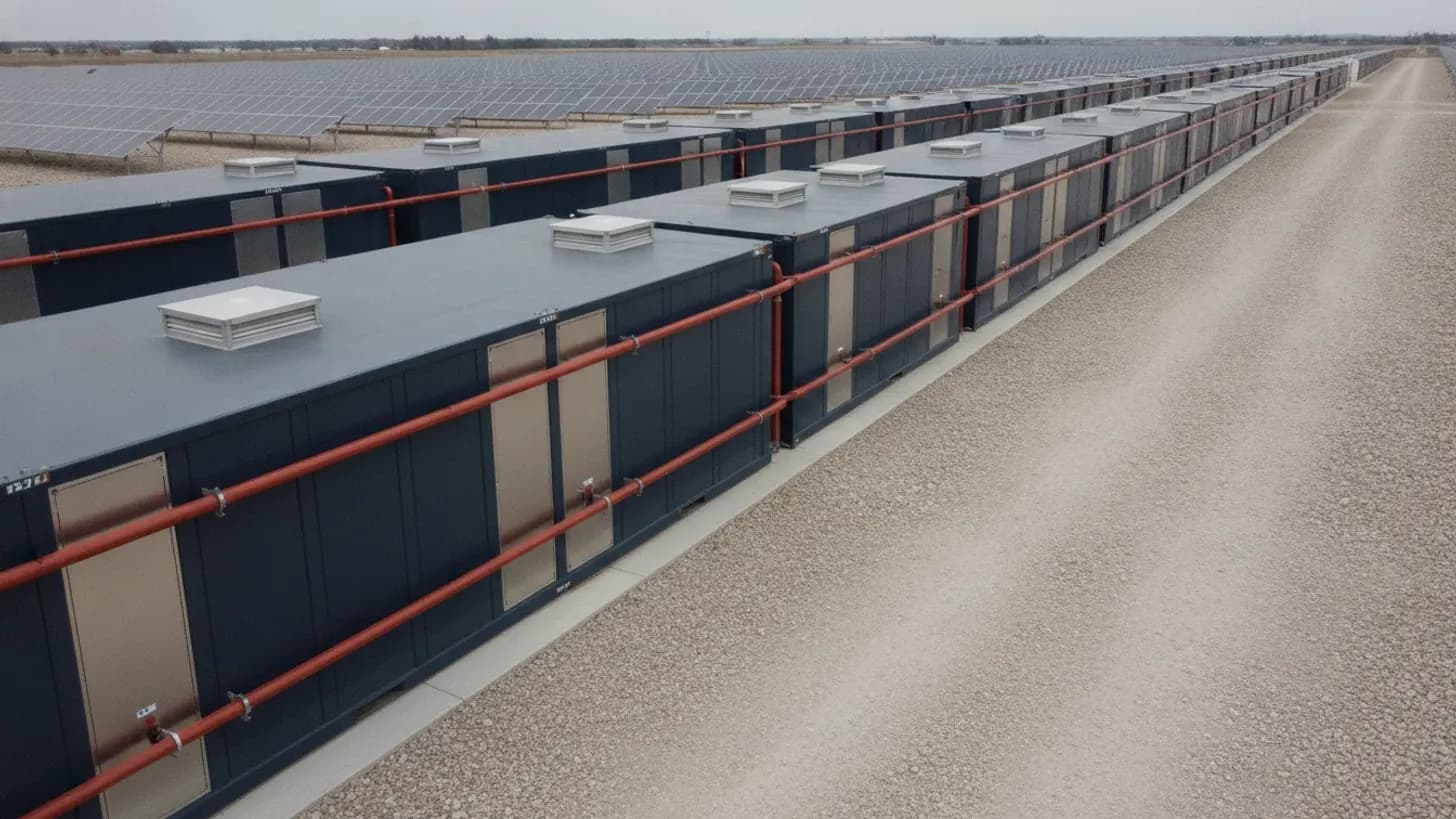
NFPA (National Fire Protection Association) 855-2023 caps indoor lithium-ion battery energy storage system (BESS) installations at 600 kWh per fire compartment before special engineering controls come into play, and that one number reshapes how co-located storage gets laid out. BESS fire safety NFPA 855 solar compliance is not a permit-day formality: it drives enclosure spacing, suppression sizing, gas detection, and the alarm points your SCADA host has to carry from the first day of commissioning.
What BESS fire safety NFPA 855 solar limits apply to indoor and outdoor enclosures?
NFPA 855-2023 limits indoor lithium-ion BESS installations to 600 kWh per fire compartment without special engineering controls, and holds a single ESS unit to 50 kWh in most occupancies. Outdoor containerized blocks at utility-scale solar plants work to separation distances instead, starting at 3 ft between units.
Those thresholds are the spine of BESS fire safety NFPA 855 solar design, because suppression sizing, gas detection coverage, and the alarm tag list your SCADA host carries all follow from how stored energy is divided. A fire compartment is fire-rated construction with rated penetrations, not a drawing convention, so the 600 kWh ceiling forces either more compartments or a documented engineering case built on large-scale fire test data.
Most co-located capacity sits outdoors. NFPA 855 then works through clearance: 3 ft between ESS units, and 10 ft from lot lines, buildings, public ways, and stored combustible material, unless UL (Underwriters Laboratories) 9540A testing supports a tighter layout. The US Department of Energy energy storage safety program and the EPRI Energy Storage Integration Council publish reference material on how that test data feeds enclosure spacing, and utility-scale battery storage capacity keeps climbing as more of that spacing work gets done.
| Parameter | NFPA 855-2023 default | How projects exceed it |
|---|---|---|
| Stored energy per ESS unit | 50 kWh (20 kWh in dwelling units) | Listed unit plus UL 9540A data accepted by the AHJ |
| Stored energy per indoor fire compartment | 600 kWh | Added rated compartments or an approved engineering case |
| Spacing between ESS units | 3 ft | Test data showing no propagation at a shorter distance |
| Separation to lot lines, buildings, public ways | 10 ft | Fire-rated barrier wall or accepted test-based analysis |
Treat the table as a starting position, not a verdict: every BESS fire safety NFPA 855 solar submittal is approved by an authority having jurisdiction, and projects that assumed the default numbers during design often renegotiate them during permit review.
How does BESS fire safety NFPA 855 solar design handle suppression and ventilation for lithium-ion batteries?
Suppression and ventilation are sized from UL 9540A large-scale fire test data for the exact cell, module, unit, and installation combination being deployed. NFPA 855 asks for explosion control, detection, and suppression matched to the gases the tested product actually vents, not to a generic occupancy class.
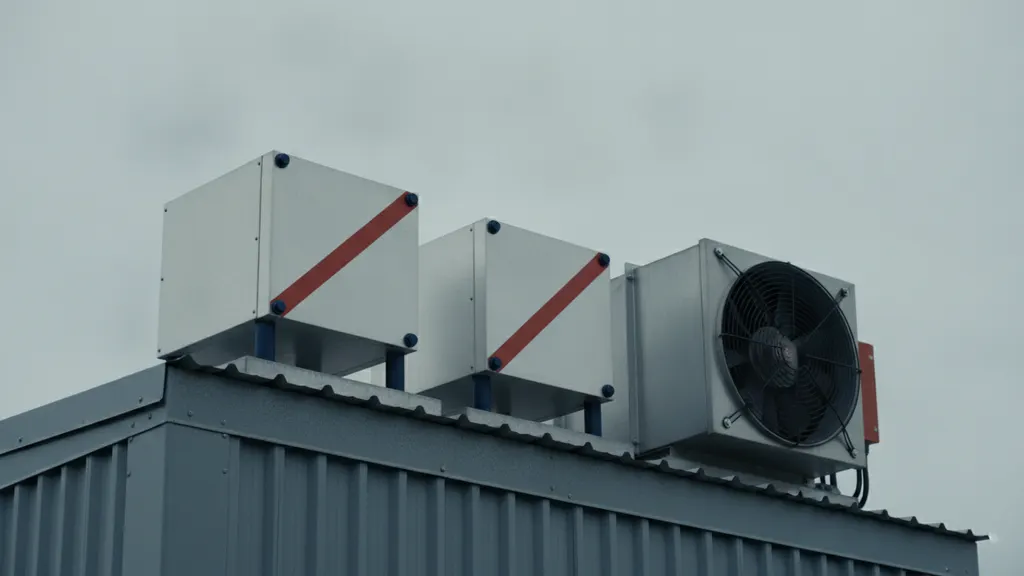
Two paths satisfy the explosion control requirement. Deflagration venting under NFPA 68 gives the pressure wave a designed exit through vent panels sized to the enclosure. Explosion prevention under NFPA 69 keeps the flammable gas concentration below the lower explosive limit using combustible gas detection interlocked to mechanical exhaust. Outdoor walk-in enclosures at utility-scale solar plants commonly use both: vent panels on the roof or door face, plus an exhaust fan that starts on a first-stage gas alarm.
Ventilation is the part of BESS fire safety NFPA 855 solar design that gets value-engineered first and regretted later. If the exhaust fan is not on backup power, it stops working in exactly the fault condition it exists for. Off-gas detection at the module level buys minutes before smoke detection sees anything, which is why NIST fire research on lithium-ion battery failure keeps pointing at early gas signatures as the practical detection layer.
IEC 62619 thermal runaway detection inside BESS fire safety NFPA 855 solar design
IEC 62619:2022 requires the battery management system to detect thermal runaway and initiate protective action before cell temperatures exceed defined safety thresholds. That is a product-level duty on the BMS, and it is the layer NFPA 855 assumes is already working when it writes installation rules.
In practice the BMS watches cell voltage, cell and module temperature, temperature rate of rise, and the spread between the hottest and coldest cells in a string. Crossing a threshold opens contactors, isolates the rack, and raises an alarm. The IEC 62619 standard also covers propagation behavior, so the question is not only whether one cell fails but whether the failure stays inside one module. None of that helps if the alarm dies inside the battery OEM local HMI. BESS fire safety NFPA 855 solar programs live or die on whether those points reach the control room, which is a BESS SCADA integration problem as much as a fire problem. Map thermal runaway pre-alarm, gas detection stage 1 and stage 2, exhaust fan run status, and E-stop state as discrete tags, then rationalize them against ISA-18.2 alarm management practice so they do not sit in the same queue as inverter nuisance trips. The SCADA alarm rules guide covers that priority split.
Emergency response and hot work permits for BESS fire safety NFPA 855 solar sites
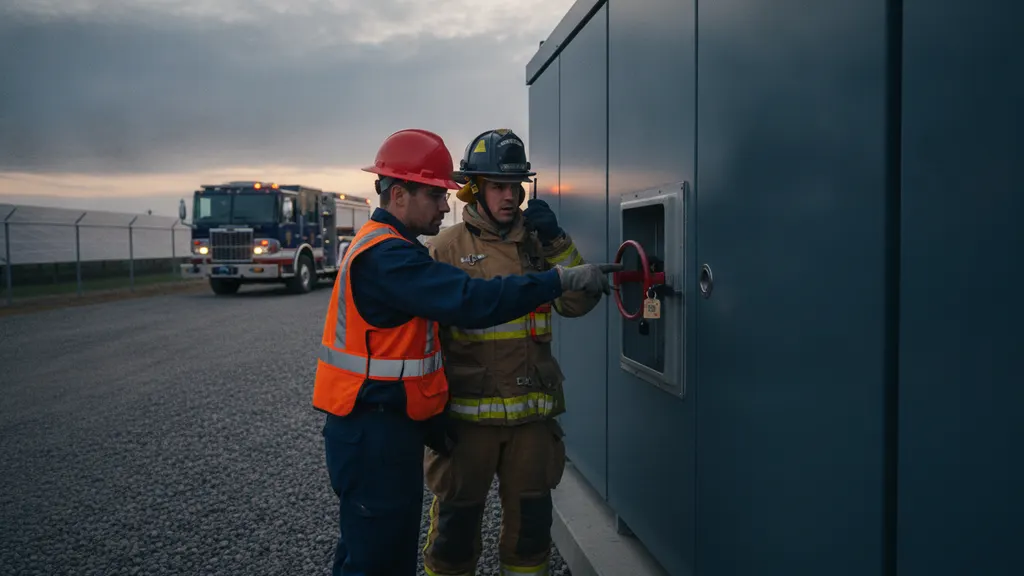
NFPA 855 requires a hazard mitigation analysis and an emergency operations plan filed with the authority having jurisdiction, plus training for the responders who will actually arrive. On a rural utility-scale solar site well outside a paid department response radius, that plan is the response.
The hazard mitigation analysis walks the failure modes: thermal runaway in a single module, failure of the BMS to act, failure of ventilation or exhaust, and voltage still present after shutdown. Each one needs a documented consequence and a mitigation. The April 2019 battery storage fire at Arizona Public Service's McMicken facility in Surprise, Arizona, is the reference case for why this matters: responders opened an enclosure without knowing stranded energy and off-gas were still building inside, and the explosion that followed sent firefighters to the hospital. That incident is a large part of why NFPA 855 now treats hazard mitigation analysis and responder training as a commissioning gate rather than paperwork. The emergency operations plan turns that analysis into site-specific instructions covering enclosure layout, isolation points, what not to open, water application guidance, and contacts. Run it as a tabletop exercise with the local department before commissioning, not after.
Hot work inside a battery yard needs a permit process under NFPA 51B with a fire watch and a documented exclusion zone around energized enclosures. Stranded energy is the trap, since a DC bus can stay live after the AC side is open, so lockout and tagout has to cover both. OSHA 29 CFR 1910.303 requires arc flash hazard labeling on BESS electrical enclosures operating above 50 volts, and the incident energy behind those labels comes from a study, not a template. The solar farm arc flash analysis guide covers the NFPA 70E and IEEE 1584 method. Permit discipline is where compliance programs get tested in year three, not year one.
What inspection intervals keep BESS fire safety NFPA 855 solar compliance current?
NFPA 855 sends routine ESS maintenance to the manufacturer published instructions and the product listing, then holds the fire protection systems to their own standards. Sprinklers follow NFPA 25, detection and alarm follow NFPA 72, and the battery system follows the interval the OEM documented.
That split confuses O&M teams, so build one schedule that carries both. Annual items usually include thermographic inspection of terminations and busbars, torque verification on a sampled basis, gas detector calibration at the manufacturer stated interval, HVAC filter and refrigerant checks, BMS event log export and review, and the fire system inspections the AHJ will ask to see. State of health testing and capacity checks follow the warranty terms. Work from NREL on storage operations and reliability is a useful reference when building the plan.
Keep the records where the fire marshal can read them. BESS fire safety NFPA 855 solar compliance is judged on documentation during inspection, and a site with perfect maintenance and no paperwork fails the same as a site with neither. Fold the safety points into the SCADA commissioning witness pack so the sequence tests, gas alarm to exhaust start to contactor open to control room alarm, are proven once in front of the utility and recorded.
Frequently asked questions
How much battery storage can I put indoors under NFPA 855?
Indoor lithium-ion installations are held to 600 kWh of stored energy per fire compartment before special engineering controls are required, and each ESS unit is capped at 50 kWh in most occupancies. Going past either figure is possible, but it takes large-scale fire test data and an approved engineering case, not a design preference. For co-located solar this is usually the point where BESS fire safety NFPA 855 solar planning pushes capacity outdoors into separated enclosures. The SEIA energy storage safety resources give useful background on how developers handle that siting decision.
Does NFPA 855 require sprinklers inside a battery enclosure?
It depends on the installation type and the listing. Indoor ESS rooms inside buildings are generally protected by an automatic sprinkler system designed from large-scale fire test results rather than a generic hazard classification. Outdoor listed enclosures may instead rely on the suppression that was tested and listed with the unit, with the site providing water supply and fire service access. The decision belongs to the authority having jurisdiction and the tested product data. NIST fire research on battery energy storage covers why test-derived design beats assumption here.
What does IEC 62619 actually require a battery management system to do?
IEC 62619:2022 requires the battery management system to detect thermal runaway and initiate protective action before cell temperatures exceed defined safety thresholds. In practice that means continuous monitoring of cell voltage and temperature, rate-of-rise logic, and an automatic response that isolates the affected rack and raises an alarm. The standard also addresses propagation, so a compliant design has to show that a single cell failure does not cascade through the module. The IEC standards catalogue lists the current edition and its scope for industrial applications.
How far apart do outdoor BESS units have to be?
The NFPA 855 default is 3 ft between ESS units and 10 ft from lot lines, buildings, public ways, and stored combustible material. Those distances can be reduced where UL 9540A large-scale fire testing shows the tested unit does not propagate fire to a neighboring enclosure at a shorter spacing and the authority having jurisdiction accepts the analysis. Most BESS fire safety NFPA 855 solar layouts on utility-scale sites are driven by that one table plus access roads for fire apparatus. EPRI energy storage research publishes work on separation and propagation testing.
Do I need arc flash labels on battery enclosures?
Yes. OSHA 29 CFR 1910.303 requires arc flash hazard labeling on BESS electrical enclosures operating above 50 volts. The label has to reflect a real incident energy study for the DC and AC sides of that equipment, not a generic warning sticker, and it should match the PPE category your work instructions assign. DC arc flash analysis on battery systems uses different methods from the AC switchgear study, so a plant that only analyzed the medium voltage yard still has a gap at the battery racks.
How often should an operating BESS be inspected?
NFPA 855 defers routine ESS maintenance to the manufacturer published instructions and the product listing, while fire protection systems follow NFPA 25 and NFPA 72 on their own schedules. Most operating plants settle on an annual cycle for thermographic scans, torque sampling, gas detector calibration, HVAC service, and BMS log review, with more frequent checks where the OEM says so. Keeping BESS fire safety NFPA 855 solar records current matters as much as the work itself, since inspections are judged on documentation. NREL storage reliability research is a reasonable benchmark for building the plan.